One Week. Two Hemispheres. The Same Warning to Old Parties.
Reform UK surged first, then One Nation broke through in Farrer. Near-polar opposites sent the same message about voter trust.

NEED TO KNOW
Reform UK’s gains in Britain and One Nation’s breakthrough in Farrer are not simply signs that voters have become louder, angrier or more extreme. Representational failure is the deeper mechanism: established parties are losing the authority to carry identity, explain pressure and turn grievance into credible political action. Albanese and Starmer may benefit from right-wing disorder today, but both inherit the same impatient voters tomorrow.
———
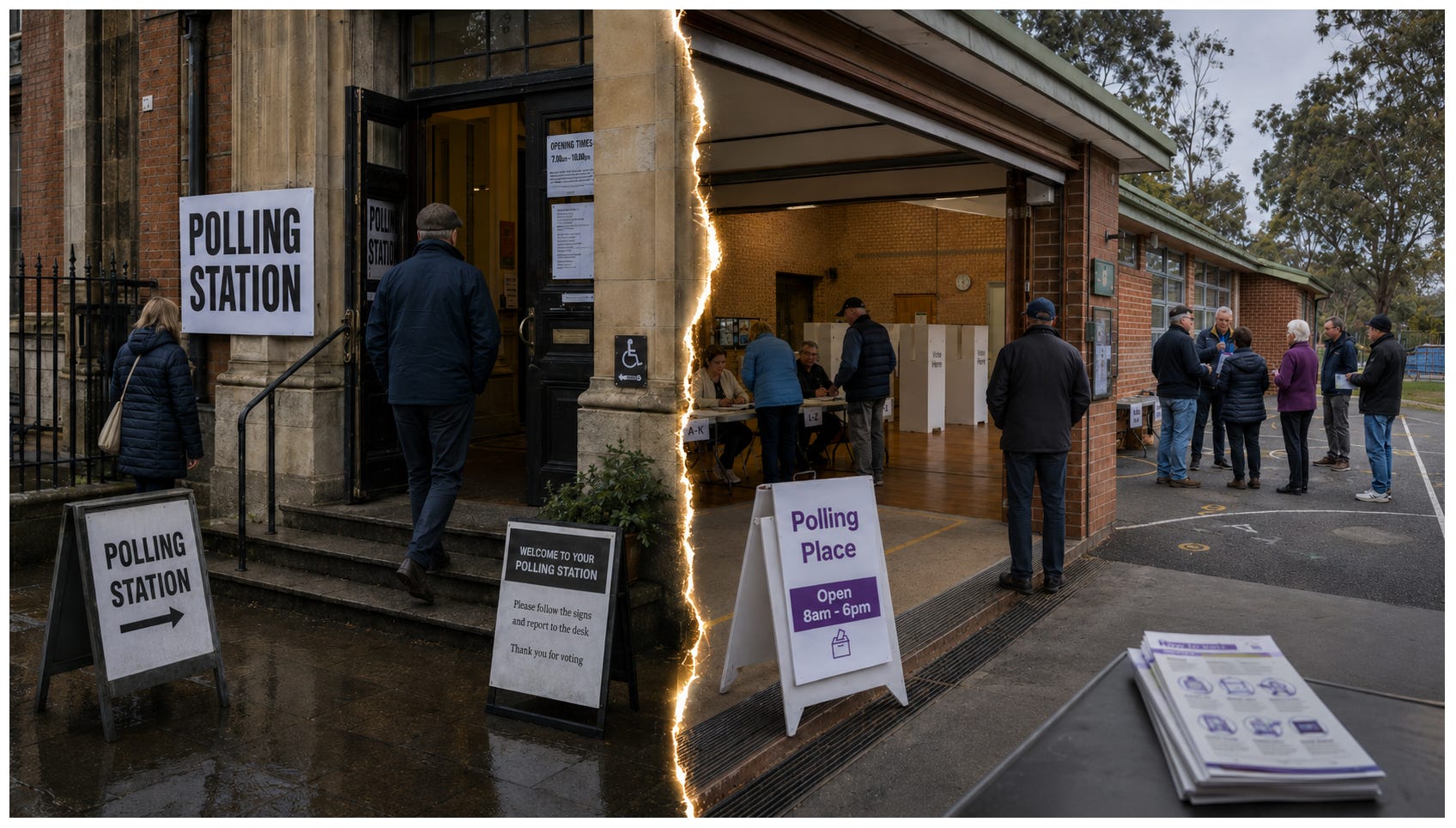
One week, two hemispheres, and the same warning: old parties are losing their grip on voters they once assumed would come home.
⸻
Within the space of a few days, Reform UK in Britain and One Nation in Farrer turned distant elections into the same warning for old parties.
First came the British results, where Reform UK showed how far voter frustration had moved beyond the old Conservative-Labour frame. Then Farrer followed on Saturday, giving Australia its own version as One Nation turned Coalition weakness into a lower-house breakthrough.
Near-polar opposites make the comparison harder to dismiss. One sits in compulsory-voting Australia, near the Antarctic edge of the democratic map, where preferences and party cards are supposed to discipline insurgent votes. Reform UK sits in voluntary-voting Britain, nearer the Arctic, where first-past-the-post can turn fractured loyalty into brutal seat arithmetic.
Calling it a right-wing surge is too convenient. Such a label makes the challengers look like the whole cause rather than the most visible symptom.
Voters can see the failure in ordinary ways. A bill goes up, a rent notice arrives, a doctor is harder to see, a road is still not fixed, and a party volunteer at a school hall hands over a how-to-vote card as if old instructions still carry old weight.
Farrer was the moment a Coalition authority problem moved from internal theatre to public consequence.
By February, the Coalition was already asking voters to treat theatre as repair. Sussan Ley was gone, Angus Taylor had the reins, Jane Hume became deputy, and the performance was meant to suggest renewal.
Plenty of voters could see the horse had not changed. A saddle had moved, a jockey had changed, and the dead weight remained.
Liberal and National reunion carried the same problem. Reconciliation was the public language, but co-habitation under pressure was the political reality.
Voters can tell the difference between shared purpose and shared vulnerability.
Farrer did not suddenly invent this judgement. A ballot paper simply gave voters a place to record it.
One Nation did not need to manufacture all the anger. It only had to inherit the political space the Coalition had vacated.
Calling that merely a protest vote understates the break. Protest still assumes the old party might listen, adjust and recover. Representational detachment begins when voters stop granting an old party the right to interpret the pressure in their own lives.
Old conservative warnings depend on obedience. Vote One Nation, get Labor. Send a message if you must, but come home when the serious counting begins.
Farrer suggests some voters no longer accept the premise. A how-to-vote card only works when the voter still recognises the authority behind it. Once that authority goes, the card becomes another scrap of paper in a noisy room.
Reform UK is doing something similar to the Conservatives, but under British rules. Nigel Farage is not Pauline Hanson in another postcode, and Reform is not One Nation with a British accent.
Britain brings a different machine to the same stress. First-past-the-post, post-Brexit exhaustion, local council anger, Westminster churn, old Tory territory, Labour heartlands and towns promised change while still feeling managed rather than heard.
Reform is not merely splitting votes. Reform is claiming emotional territory the Conservatives thought Brexit had secured.
Britain’s fracture is wider than Reform. Greens, Liberal Democrats, Plaid Cymru and the Scottish National Party are also pulling against the old two-party frame, each in different places and for different reasons.
Right-wing challengers are the loudest warning light, not the whole dashboard.
Australia has its own version. One Nation, Greens, teals, independents and unaffiliated voters all point to a weaker grip by old parties. Australian Election Study findings have been showing weakening party identification and rising distrust for years.
Major parties are not just losing votes. Major parties are losing custody of meaning.
Cost of living is not just an economic category when the weekly shop feels like a small ambush. Housing is not just supply and demand when adult children cannot leave home or renters wait for the next increase. Immigration is not just a population setting when people connect it, fairly or unfairly, to pressure on roads, housing, services and wages.
Net zero is not just climate policy in many regional ears. Water, health, energy and local services can become proof that someone somewhere else makes decisions while ordinary people absorb the cost.
Major parties still answer too often with process. Many voters are asking for recognition.
Challenger parties live in that gap.
One Nation and Reform UK may be crude, risky, opportunistic or inconsistent. None of that makes the voter signal trivial. Voters do not need to be noble for their behaviour to reveal something real.
Every serious party should ask why old political brands have become so weak at carrying the pressures many voters feel.
For the Coalition, Farrer is not only a preference-management problem. Farrer is an authority-management problem.
If conservative voters no longer accept Liberal and National cues, the Coalition cannot negotiate its way around One Nation with slogans, cards and leadership theatre. It has to rebuild the reason voters should believe it again.
For the Conservatives in Britain, the problem is even sharper. Reform is not only taking votes. Reform is trying to become the emotional home of the right.
Copying Reform may validate it. Ignoring Reform may look deaf. Sneering at Reform voters may turn alienation into identity.
Albanese and Starmer are not outside this story; both are temporary beneficiaries of it.
In Australia, One Nation’s Farrer breakthrough damages the Coalition first. The mood underneath it does not belong to the Coalition. Voters squeezed by housing, bills, migration pressure, services and mistrust can turn on Labor just as quickly if government sounds like it is managing pressure rather than understanding it.
In Britain, Starmer faces the same danger in harsher weather. Labour can win office because Conservatives collapse and still lose authority if voters decide it has inherited the system rather than changed it.
Reform may wound the Conservatives most visibly, but it also hunts in places where Labour cannot afford to sound metropolitan, procedural or bloodless. Labour can also bleed leftward to Greens, Liberal Democrats, Plaid Cymru or the Scottish National Party.
Right-wing challengers are not merely opposition problems. They are warning lights for incumbents.
By-elections can exaggerate. Local elections can distort. Candidate quality matters, and electoral systems still protect established parties more than their reputations deserve.
A deeper faultline looks more durable than one result.
Voters are less deferential, party loyalty is weaker, media habits are more fragmented, and old class and regional identities no longer sit neatly inside the containers built for earlier political generations. Immigration, sovereignty, housing and trust have become arguments about who gets heard and who carries the cost.
Major parties can still win elections. Governments can still be formed. Incumbents can still benefit when the other side breaks first.
Winning office is not the same as owning public confidence.
One Nation and Reform UK are symptoms of a deeper political break: voters are no longer waiting for old parties to tell them what their own lives mean.