Nothing Stays Bought Anymore
Products fail, repairs cost too much, and councils should help communities make fixing things easier than throwing them away.

NEED TO KNOW
Planned obsolescence is the business logic behind products that break, date, slow down or become too expensive to repair. The answer is not just anger at companies, but rebuilding local repair culture so fixing, borrowing tools, sharing skills and maintaining useful things become normal again. Councils should stop acting like repair is a risk problem and start treating it as civic infrastructure, because repair should not be harder than landfill.
———
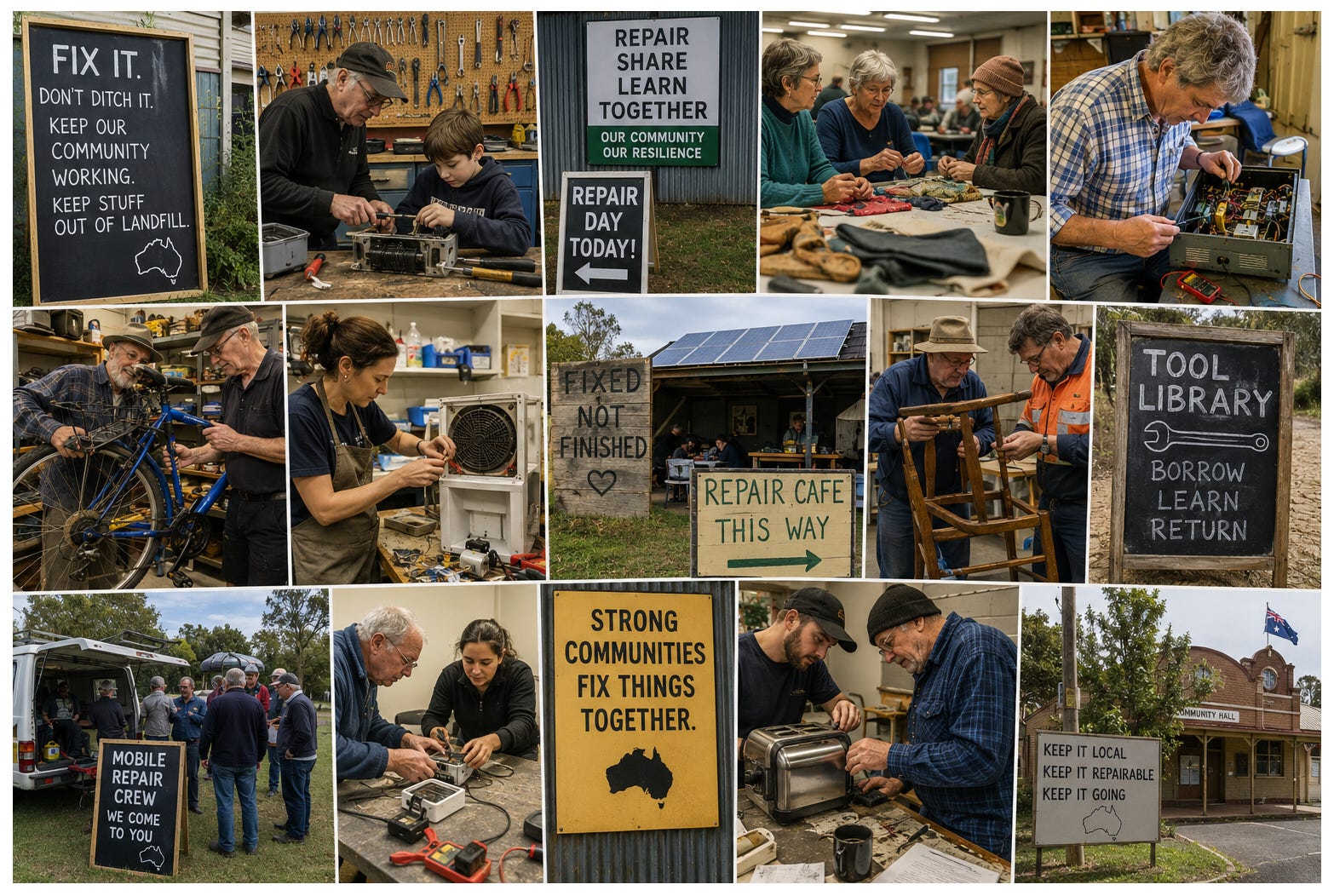
Modern business profits from replacement. Communities need to make repair normal again.
⸻
Modern products are not built to last because lasting is bad for business, but communities do not have to keep treating landfill as the default answer.
Everyone knows the trigger. The washing machine dies just outside warranty, the phone slows after a few updates, and the appliance needs one part that somehow makes replacement look sensible.
People do not need an economics degree to recognise the pattern. A repair costs nearly as much as a new product, the battery is sealed inside, the part is unavailable, or the newer model is already being pushed before the old one has properly died.
Australian households are being trained into a replacement economy where nothing really stays bought anymore.
A company does not become hugely profitable selling one good fridge every twenty-five years. Retailers do not thrive because your shoes can be repaired forever. Shareholders do not celebrate because your television, washing machine and phone quietly keep working year after year.
Modern business rewards movement, and planned obsolescence is what that movement looks like inside ordinary homes.
Warranties expire, materials get cheaper, repair networks shrink and replacement becomes easier than maintenance. Nobody needs to secretly coordinate the whole system when the incentives already point in the same direction.
Working families feel the pressure first because every breakdown becomes a household budget decision. Replace the thing or pay nearly the same amount to repair it. Buy the cheaper version because money is tight, then replace it again sooner.
The old assumption was that expensive household goods should stay alive long enough to justify the money spent on them.
Radios got repaired, furniture stayed in families, and shoes got re-soled. A broken appliance was frustrating, but people assumed it could probably be fixed rather than sent straight to the tip.
Modern consumer life has changed that bargain. Products may cost less upfront, but the real expense arrives later through upgrades, subscriptions, replacement cycles and repairs that no longer make economic sense. During a cost-of-living squeeze, that does not feel like progress. It feels like permanently leaking money.
Repair culture matters because it gives ordinary people a practical way to push back against a market built on replacement.
Repair is not nostalgia or some quirky weekend hobby for people who like tinkering in sheds. It is the counterweight to a system that keeps telling people to throw away value and buy it again.
Local repair culture cannot be left to one brand, one group or one monthly event. Communities need tool libraries, repair days, maker spaces, Men’s Shed partnerships, school workshops, TAFE links and community halls where people can bring broken things, borrow tools, share skills and keep useful products alive.
Local government should not make community repair harder than landfill.
Councils already organise markets, festivals, sportsgrounds, clean-up days, libraries and community grants. A council that can coordinate those things can also help residents keep useful products out of the tip through halls, small grants, insurance pathways, local repair directories and tool-sharing programs.
Some councils will instinctively reach for liability, electrical compliance, storage concerns, risk management and volunteer paperwork before the first screwdriver hits the table. Those concerns are not imaginary, but they should be problems to solve rather than excuses to bury the idea.
Councils need to stop treating practical community repair as a problem to manage and start treating it as civic infrastructure.
A suburb with a library and community hall can also support local repair days. A town that can organise food drives and weekend markets can also help residents keep useful things in circulation instead of treating replacement as the only realistic option.
Some replacement is genuine progress. Safer cars, efficient appliances, better batteries and stronger software security matter. Nobody sensible wants to freeze technology in 1978 and pretend that is wisdom.
The lie is pretending every replacement cycle is progress when many of them are just profit dressed up as necessity.
Modern consumer society works smoothly only if people accept temporary ownership as normal life. Rebuilding a culture where durability, maintenance and repair are treated as normal again pushes back against that logic.
The most powerful protest against planned obsolescence is brutally simple: keep the thing, repair the thing, and make it easier for every community to do the same.
Is your local council helping or hindering? Share your experience with local repair groups or the “too expensive to fix” trap in the comments.