Ministers Are Using Senate Adjournments to Bury Bad News
Accountability demands a live chamber; the government exploits Senate and House rules to wait until the chamber doors are locked and the Senators and Members have left the building.

NEED TO KNOW
Ministers weaponise administrative downtime to table responses when the Senate or House cannot hold them to account. Veterans Minister Matt Keogh has joined the Conga Line of avoiders. Albanese Labor’s rejection of Senate committee recommendations on Australian Defence Force (ADF) superannuation reforms was buried at 12:16am to guarantee public silence. This tactic neutralises veteran advocacy by ensuring policy failures never face timely Senate debate or media heat.
———
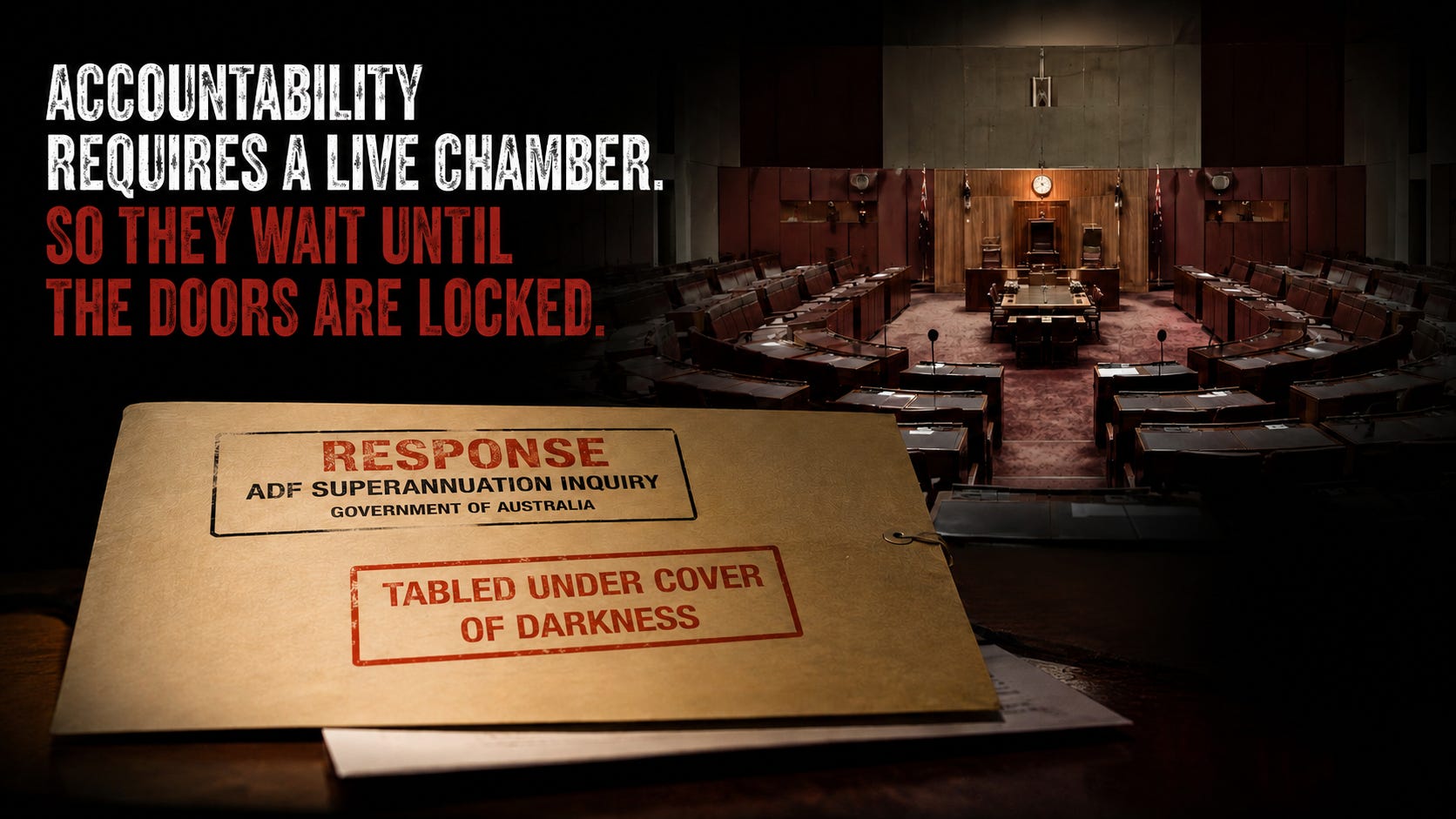
Albanese Labor’s government response didn’t miss scrutiny, it dodged it!
⸻
Bureaucratic inertia serves as a powerful shield against transparency.
Veterans champion, Senator Jacqui Lambie initiated the inquiry by the Senate Standing Committees on Finance and Public Administration into the operation and appropriateness of the superannuation and pension schemes for current and former members of the ADF, aiming to expose systemic failures.
Veterans see a system that grinds to a halt when hard questions emerge, leaving many behind while officials protect their own processes. Official responses are frequently designed to avoid the very people they are meant to serve.
Distrust festers because administrative convenience routinely overrides veteran justice.
Ministers use Senate standing orders to table responses out of session via the Table Office, bypassing the spotlight of the chamber floor. Departments utilise the Prime Minister and Cabinet (PM&C) tabling system to process these documents and trigger automated email alerts, ensuring the release happens under the cover of darkness. My own alert arrived at 12:16 am, proving that timing is a calibrated mechanism for suppressing dissent.
Procedure is now being used to prioritise institutional convenience over accountability.
Old hands know that tabling documents once the chamber has emptied is an ancient trick, yet digital integration now makes this evasion faster and more surgical than ever. Observers once expected debates to drive change, but the system now demands only a paper response, regardless of how many recommendations are ignored. Such trade-offs protect agencies from disruption while leaving underlying failures regarding service-related harm, financial inequity, and institutional drift entirely untouched.
Seventy-eight submissions to the Lambie inquiry detailed systemic harm and proposed clear reforms, yet the government rejected eight of the ten recommendations. Officials preserved their power to block applications, ignored the disconnect between the Commonwealth Superannuation Corporation (CSC) and the Department of Veterans’ Affairs (DVA), and kept penalties based on obsolete data.
Senator Jacqui Lambie published additional comments in the report, the kind historically recognised as dissenting or minority reports, drawing directly on evidence from veterans. Because her remarks were not included in the committee’s formal recommendations, the Government had no obligation to respond. That is how powerful testimony gets recorded, then ignored.
Veterans Minister Matt Keogh ensured Albanese Labor complied with the Senate rules and delivered a government response into the committee inquiry, but the reply was buried by timing.
Veterans Count exists for this very reason. It tracks input on the issues of concern to veterans and their families, turns a hidden footprint into a chorus by counting veteran-connected Australians by federal electorate, and ensures our presence is visible, measurable, and impossible for local MPs to ignore.
If you are connected to the Navy, Army, or Air Force, past or present, add your count to your federal electorate. Watch the 60-second walkthrough at veteranscount.com.au/watch.
Have you seen a Senate report disappear like this? Or has your submission been buried in silence?