Labor Copied the Panic Funnel
Britain’s stop Reform machine has been rebadged as stop One Nation, and the $27 ask is the data capture point.

NEED TO KNOW
Labor’s $27 Stop One Nation appeal is not just mid-term fundraising; it is a copied panic funnel. Britain’s Labour Party is already using a stop Reform donor-ad machine, and Australian Labor looks to have rebadged the same logic for One Nation. Voters should worry less about the small amount and more about how fear, data and political advertising are being joined before the next campaign officially begins.
———
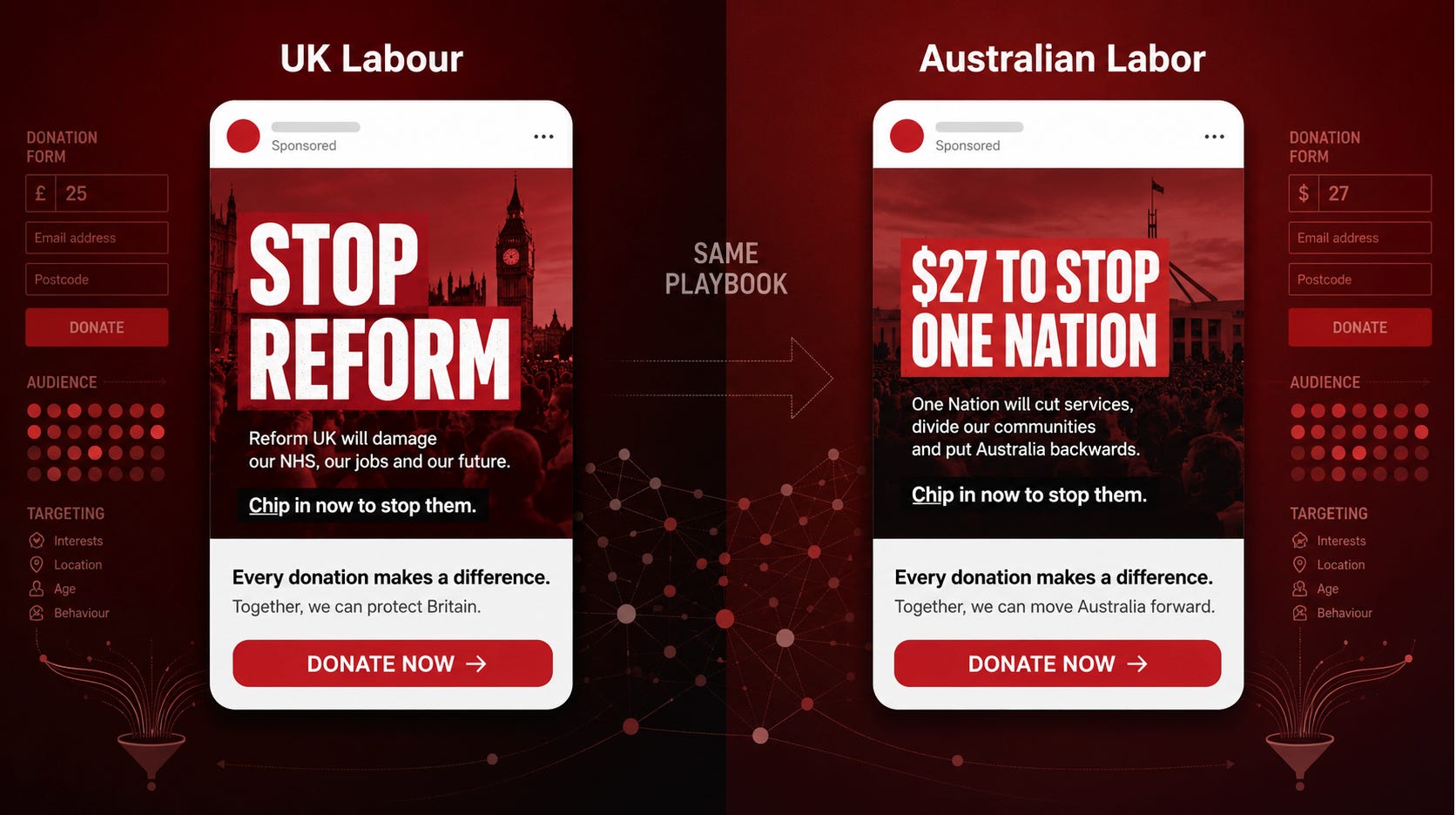
Editorial illustration: UK Labour’s “Stop Reform” appeal and Labor’s “Stop One Nation” campaign show the same panic-funnel logic.
⸻
Labor is using One Nation fear to copy Britain’s anti-Reform donation funnel before the next federal campaign officially begins.
A Daily Telegraph report says Labor has asked supporters to chip in $27 to stop One Nation turning polling momentum into seats. Ads reportedly ran on Meta from 1 June, carried the authorisation of P. Erickson, Australian Labor Party (ALP), Canberra, and used One Nation’s rise as the reason to act now.
Campaign ads during formal election campaigns are ordinary. Marginal seats need money, online ads need testing, and parties use fear as a broom to sweep passive supporters into action.
Mid-term, the same behaviour reads differently because a governing party is not merely preparing policy; it is building campaign capacity while voters are still trying to live through the term they just elected.
Small donation asks turn passive sympathy into a usable campaign signal. A person who gives $27 is not only a donor. They are a named, contactable, emotionally sorted supporter who has shown which message moved them.
Meta’s advertising architecture makes that valuable. Meta says custom audiences can be used to create lookalike audiences, meaning advertisers can reach new people similar to people already engaging with them. That does not prove the exact settings Labor used, but it explains why a low-friction donation funnel matters.
Australian Labor’s own privacy page fills in more of the picture. Labor says it generally collects names, addresses and preferences when people stay up to date, collects information through petitions and surveys, uses cookies, collects information on third-party platforms when users agree, and uses information to personalise and customise online experience and communication.
Britain supplies the giveaway: United Kingdom Labour Party (UK Labour) already runs an official page asking people to donate to stop Reform.
UK Labour’s page says Reform UK opened a funding gap, says donations will supercharge ads, fund campaign teams in Reform target seats, and power rapid response against Reform messaging. That is not merely an appeal for cash. It is a public sketch of the machine: enemy, anxiety, donation, list, ads, target seats, repeat.
Replace Reform with One Nation and the Australian version looks painfully familiar.
Political parties borrow tactics all the time. What makes this one interesting is not originality, but desperation. Labor is not treating One Nation as a protest vote to be argued with later. It is treating One Nation as a digital insurgency to be mapped and mined now.
Australian Electoral Commission (AEC) guidance makes the legal baseline clear. There is no Commonwealth Electoral Act 1918 limit on the amount, format or timing of electoral communication, and authorisation requirements are not limited to election periods.
Ministerial and Parliamentary Services (MaPS) guidance makes the integrity line just as clear. Office expenses must not be used to solicit financial support or other non-volunteer support for any parliamentarian, political party or candidate.
Real damage lies in the blur between parliamentary communication, party persuasion, donor recruitment and audience building.
People do not experience politics as neat legal categories. They see a sponsored post, a local MP video, a party donation page, a scare message, a newsletter and another ad in the feed. After a while the labels matter less than the feeling: somebody is always campaigning at them.
One Nation becomes useful to Labor because it gives that machinery a villain. “Chip in” sounds humble. “Stop One Nation” gives the ask urgency. “Momentum into seats” turns a poll into a threat.
Supermarket loyalty cards teach the everyday version of this bargain. You think you are getting a discount. The company is learning what you buy, when you buy, what makes you return, and what might make you spend again.
For Labor, the $27 donor is not just worth $27. The person is a warm supporter, a proof of message response, a future email target, and potentially part of a wider audience model. That is the political value hiding behind the small-dollar humility.
Legal permissibility is not the same as democratic cleanliness.
Guidance from the Office of the Australian Information Commissioner (OAIC) says registered political parties are exempt from the Privacy Act 1988 when carrying out exempt political activity, and political calls, emails and texts are exempt from most spam and telemarketing rules. Parties operate inside a privileged political data space that ordinary businesses would love.
A government asking for help in the last days of a campaign is one thing. A government farming fear in the middle of a term is another. Voters are entitled to ask whether they are being informed, persuaded, recruited, profiled or harvested.
Labor’s copied panic funnel does not prove illegality; it reveals a governing party that looks scared enough to turn One Nation anxiety into campaign data before the campaign has even begun.
What do you reckon: is Labor simply fundraising, or are voters being pulled into a permanent campaign data machine?