

Audio version narrated by an AI voice.
Need To Know
The Albanese Labor government introduced a retrospective amendment to Australia’s war crimes legislation in September 2024, while investigations into alleged offences in Afghanistan were already underway. Labor said it was correcting a drafting error, but Parliament’s scrutiny committee warned the change could potentially affect criminal liability. The question is what ministers knew about those consequences, and why accountability higher up the chain of command followed a different path.
———
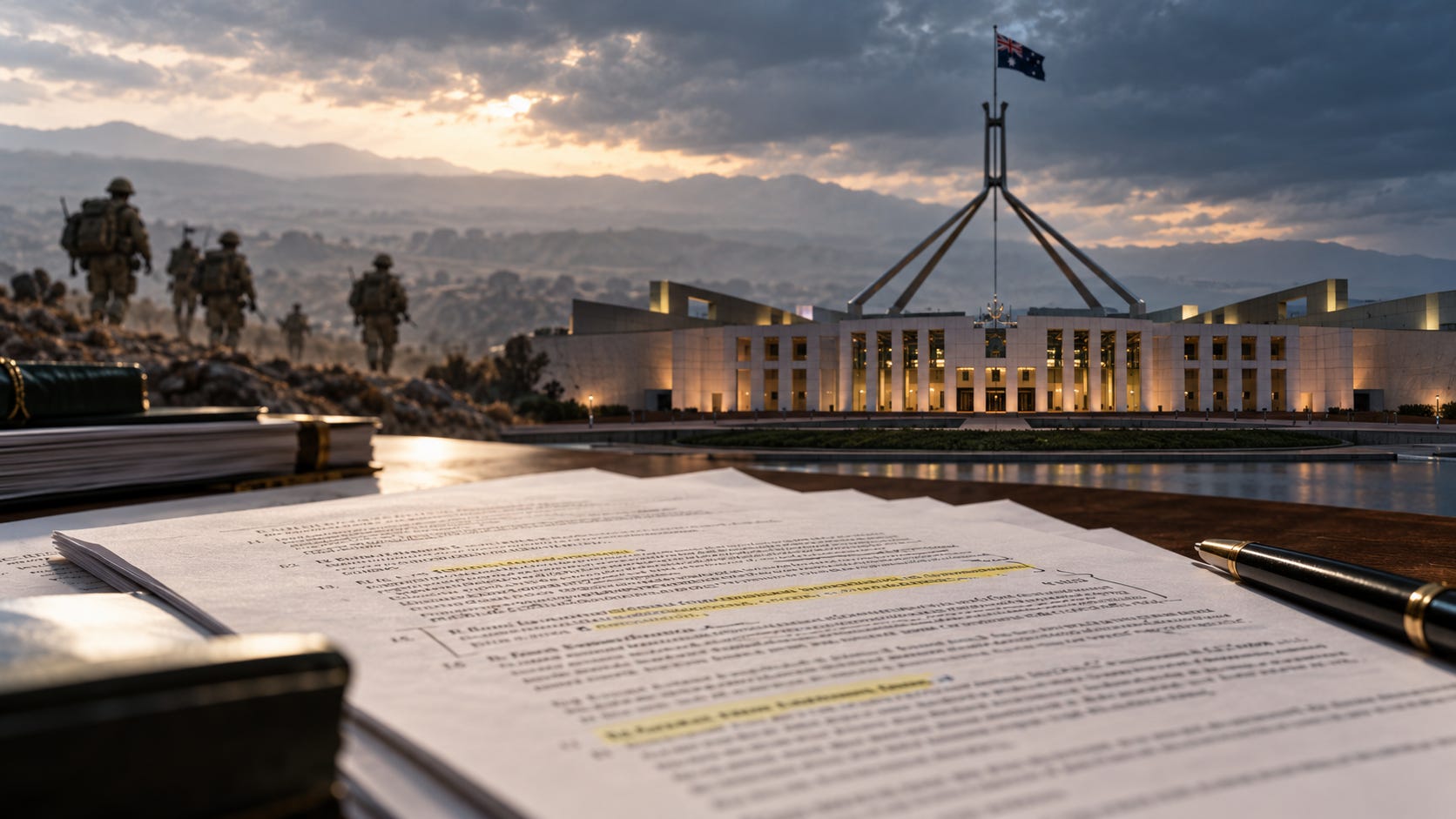
While soldiers faced scrutiny, Parliament rewrote the rules governing war crimes prosecutions.
⸻
Something Ben Roberts-Smith said during today’s interview with 2GB breakfast presenter Ben Fordham sent me looking into a decision the Albanese Labor government made in September 2024.
Fordham’s two-and-a-half-hour interview covered Roberts-Smith’s military service, legal battles and arrest. The former Special Air Service Regiment corporal received the Victoria Cross for Australia, the Medal for Gallantry and the Commendation for Distinguished Service, the Australian successor to the Imperial Mention in Despatches, an extraordinary combination of honours.
Roberts-Smith now faces five charges of war crime murder arising from Afghanistan, which he denies. His criminal responsibility remains for the courts to determine, separately from the adverse findings in his unsuccessful civil defamation proceedings.
What caught my attention was his question about why Labor changed Australia’s war crimes legislation retrospectively, while investigations into alleged offences were already underway.
Parliament defines criminal offences, investigators gather evidence and prosecutors must prove every element of a charge beyond reasonable doubt. Changing a legal definition can potentially alter what prosecutors must establish, particularly when Parliament makes the change retrospective. Labor did precisely that in 2024, while investigators were examining conduct dating back many years.
I went looking through the parliamentary records and discovered that Parliament’s own scrutiny committee had questioned the possible consequences.
Back in 2002, Parliament introduced war crimes offences into the Commonwealth Criminal Code to reflect Australia’s international obligations. One definition concerned hors de combat, French for someone who is out of the fight.
International law protects people who surrender, are captured or become incapable of defending themselves, provided they aren’t continuing to fight or attempting escape.
Unfortunately, the Australian wording contained a drafting mistake involving two ordinary words, and and or.
Imagine an enemy fighter surrendering before anyone has captured him. International law protects that person, but the original Australian definition could be read as requiring capture as well as another condition.
My writing stays free. If you’d like to help keep it going, you can chip in here.
Correcting the mistake made sense because Australian legislation was intended to reflect the international rule.
In March 2024, Labor introduced an omnibus bill dealing with digital assets, telecommunications and other matters. No war crimes amendment appeared in its original version.
By September, the government wanted to add one.
Liberal MP Paul Fletcher told Parliament that the Coalition had been assured by the Attorney-General’s office that correcting the error would preserve the law’s intended operation.
On 11 September, then Attorney-General Mark Dreyfus introduced the amendment, explaining that it would restore consistency with international law.
However, Schedule 7 expressly applied the revised definition to conduct dating back to 26 September 2002, including certain proceedings that hadn’t been finalised.
A person whose conduct occurred in Afghanistan in 2009 could potentially face proceedings applying wording amended fifteen years later.
Parliament’s Senate Standing Committee for the Scrutiny of Bills warned that retrospectivity could expose someone to criminal liability where the previous Australian wording might not have done so.
Some relevant war crimes offences carry life imprisonment, yet the committee’s concerns couldn’t prevent Parliament passing the legislation.
Meanwhile, the Office of the Special Investigator was already investigating allegations arising from Afghanistan. Former SAS soldier Oliver Schulz had been charged with war crime murder in March 2023.
A cynical observer might wonder whether Labor made the amendment retrospective to assist prosecutions already underway.
Nothing I’ve found establishes that intention, and correcting the law to reflect international obligations was a legitimate objective. Nevertheless, the investigations were underway, and retrospectivity was expressly included in Labor’s amendment.
Something else happened at almost exactly the same time.
On 12 September 2024, the day after the House agreed to the amendment, Deputy Prime Minister and Defence Minister Richard Marles announced that the government had finalised its response to the Brereton inquiry, including decisions concerning senior command accountability.
Brereton found insufficient credible information establishing criminal responsibility higher up the chain of command. However, the independent oversight panel questioned whether senior leaders had adequately accepted responsibility for organisational failures.
Marles said he had made decisions concerning commanders’ awards but couldn’t disclose individual outcomes.
Back on 8 April, I raised this apparent imbalance in Justice Cannot Stop at Corporal, questioning why criminal accountability appeared concentrated at patrol level while responsibility higher up the command structure followed another process.
Criminal responsibility and command accountability aren’t identical, but both deserve scrutiny when examining what happened in Afghanistan.
Nor does the timing establish that Labor’s amendment and Marles’s announcement were coordinated.
What remains unanswered is what advice Dreyfus received about the amendment’s possible effect on existing investigations. Were prosecutors consulted, and what assessment of those consequences was provided to Parliament?
Australia must investigate credible allegations of war crimes and prosecute offences where guilt is established. Anyone accused is equally entitled to the full protections of a fair criminal justice system.
Labor had a legitimate reason to correct the drafting error, but its decision to reach back 22 years while investigations were underway deserves a clearer explanation of what the government knew and why it chose retrospectivity.
Should Labor disclose what advice it received about the possible effect of its retrospective amendment on existing war crimes investigations? Let me know your thoughts in the comments.
I can only describe how I felt reading this as an epiphany of horror. What a witch hunt. Well researched and written, Mark. Thank you.