

Audio version narrated by an AI voice.
Need To Know
Matt Keogh says the government knew about troubling practices in veterans’ services before they became television news. Departmental warnings, billing controls and ministerial briefings leave a trail of decisions that should show what was done and when. Senators can pursue that trail at the deferred estimates hearing, including advice given to the Minister, although disclosure can be contested through parliamentary procedures.
———
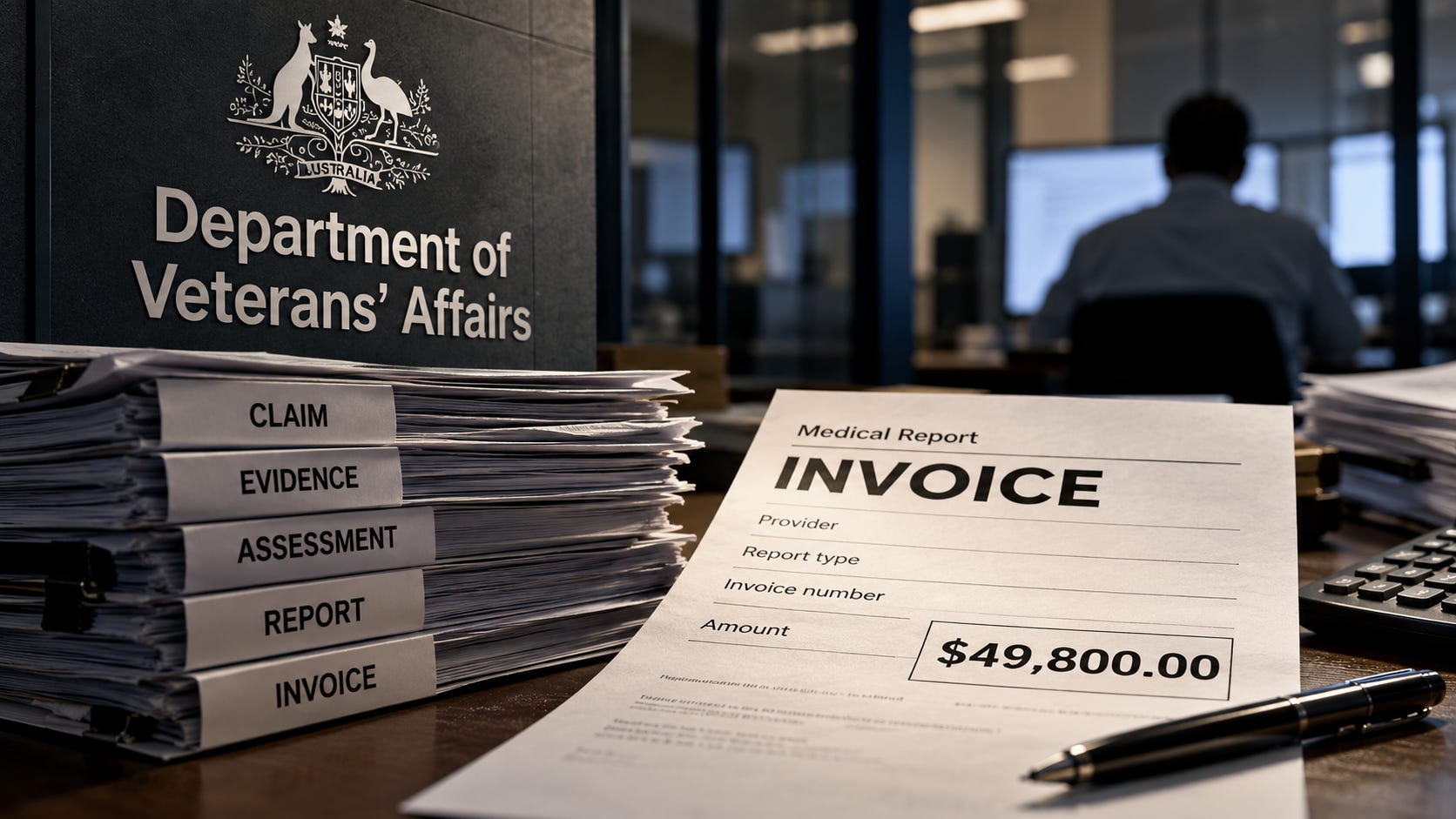
DVA paid the bills, but who was checking them?
⸻
Veterans’ Affairs Minister Matt Keogh says the government knew about problems in veterans’ services before Four Corners exposed them, which makes the next Senate Estimates hearing considerably more interesting.
On 6 October, the Minister for Veterans’ Affairs told Australian Broadcasting Corporation (ABC) Drive Melbourne that the government was already aware of providers billing for services not delivered and making misleading promises about care. He pointed to more than $200 million invested in integrity measures and investigations already under way.
Keogh’s admission wasn’t the first public acknowledgement of concerns. In November 2025, the Senate Foreign Affairs, Defence and Trade References Committee recorded the Department of Veterans’ Affairs (DVA) acknowledging that faster claims processing had, to some extent, encouraged commercial advocacy businesses and behaviour it considered concerning. Paragraph 2.31 of the committee’s report makes that clear.
DVA didn’t need a television program to tell it something was wrong with parts of the market surrounding veterans’ claims.
Fee-paid advocates lodge compensation claims on veterans’ behalf, sometimes charging a share of the eventual award. Medical assessment providers do a different job, supplying clinical evidence that may be arranged privately or requested by DVA. A report supplied with a claim is not automatically a report the department commissioned or agreed to pay for.
A compensation claim can generate private advocacy fees and publicly funded medical-report costs without either payment proving that anyone acted improperly.
Officials nevertheless told the Senate committee about claims with excessive numbers of conditions, some withdrawn after medical testing and report writing had already been paid for. They also raised concerns about businesses connecting advocacy and medical services. Those observations weren’t findings against every provider, but they explain why the department was looking more closely at the industry.
Separately, there were the medical-report bills. In Senate Estimates evidence later shown by ABC Four Corners, DVA deputy secretary Andrew Kefford told Senator Deborah O’Neill that 19 medical-report providers had charged $114 million, averaging more than $6,600 per report, with one approaching $50,000. Those were compensation reports, not podiatry or other treatment, and amounts charged are not necessarily amounts paid.
Nobody needs to prove that every expensive report was improper before asking who authorised the work and checked the bills.
Four Corners reported that the 19 providers were placed on manual invoice processing in 2025. In February 2026, DVA increased standard report fees while tightening its guidance on per-request charges, advance approval for higher fees and invoice monitoring. Earlier bills must be judged under the rules that applied at the time, but the dates of those interventions ought to be available.
My writing stays free. If you’d like to help keep it going, you can chip in here.
Which brings the story to Alison Frame. She has been Secretary since 23 January 2023, and section 19 of the Public Governance, Performance and Accountability Act 2013 requires departmental accountable authorities to keep responsible ministers informed of significant issues. Section 16 also requires appropriate systems of risk management and control.
Frame wasn’t expected to check every medical invoice herself. But what reached her office, which risks were considered significant, and what advice was passed to Keogh? We don’t know the answers, and nothing published establishes that either official ignored a warning.
Keogh has his own obligations under Prime Minister Anthony Albanese’s Code of Conduct for Ministers. Clause 5.1 requires an honest and comprehensive account of portfolio activities when Parliament or a committee makes a reasonable, genuine inquiry. Announcing integrity funding is one answer; showing what the money achieved is another.
Here’s the part I find particularly interesting. The Clerk of the Senate explained in 2006 that no Senate rule stops estimates senators asking what advice passed between a department and a minister. Advice does not become untouchable simply because it crossed a ministerial desk.
Government can resist disclosure on genuine public-interest grounds, but the Senate’s order of 13 May 2009 requires the grounds and potential harm to be identified. A senator or committee can press for the information, with a dispute potentially going to the Senate. Nobody can guarantee immediate disclosure, but merely describing something as ministerial advice does not settle the matter.
Defence ran over time at Senate Estimates on 29 October, so the committee chair released DVA and related bodies without examination and advised that a spill-over hearing would follow. Friday 20 November is a possibility, not a confirmed date. Whenever officials return, senators can ask for the dates of briefings, audit findings, ministerial responses and amounts charged, paid, withheld or recovered.
I argued in October 2025 that veterans were promised care, not a claims industry. The issue now is less about another argument between commercial operators than about what government did with information it says it already had. Veterans whose medical reports are questioned also deserve to know whether their claims will be delayed through no fault of their own.
Keogh says the government knew. Frame has statutory duties to keep him informed, and Senate practice allows questions about what passed between them. Parliament should follow that evidence before anyone congratulates themselves on having spotted the problem.
Should Senate Estimates require DVA to identify when concerns were first raised with the Minister and what action followed?