Justice Cannot Stop at Corporal

TL;DR
Ben Roberts-Smith faces serious allegations and must get the presumption of innocence and due process. Former Defence Minister Joel Fitzgibbon and former Deputy Prime Minister Michael McCormack both reinforce that standard, but the deeper question remains: why has accountability fallen hardest at the bottom while senior command appears largely untouched?
⸻
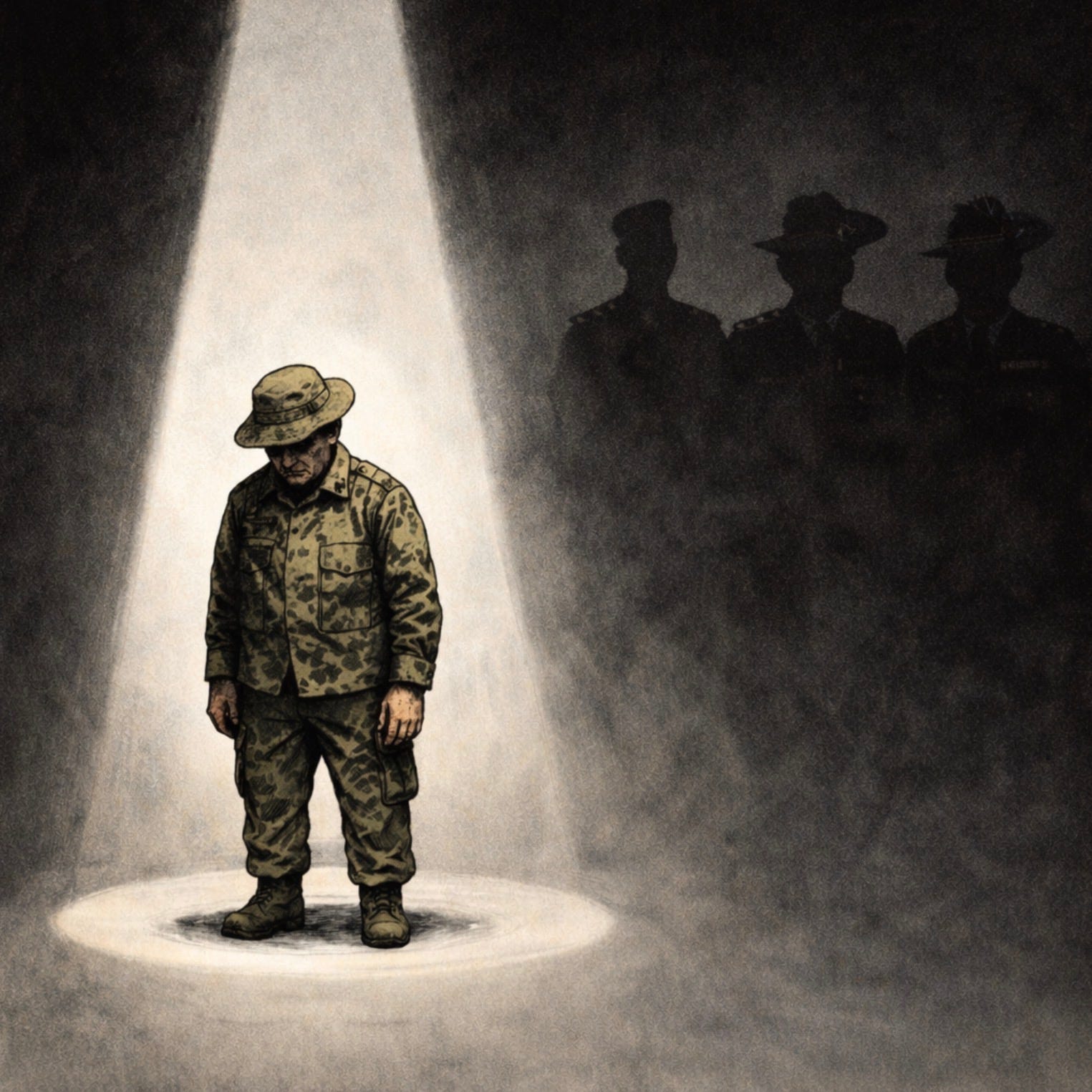
The arrest of Ben Roberts-Smith, one of Australia’s most highly decorated soldiers, a Victoria Cross recipient and a former SAS corporal, on alleged war crimes is bigger than one man.
It reaches into the hard space where service, command and accountability collide. It tests whether Australia applies its standards evenly, or only where it is easiest and safest to apply them.
Former Defence Minister Joel Fitzgibbon and former Deputy Prime Minister Michael McCormack both matter here. Fitzgibbon has argued serious allegations must be pursued, but he has also stressed the presumption of innocence must hold, while McCormack has been explicit that Australians are entitled to that same presumption until proven guilty beyond reasonable doubt.
The discipline is not optional.
Former defence ministers understand what deployed forces face because they sit through the briefings, carry the intelligence burden and live with the consequences of sending Australians into violent and morally grey theatres. Fitzgibbon’s emphasis on the presumption of innocence carries weight because it comes from experience rather than distance. It does not excuse wrongdoing, but it demands seriousness before condemnation.
McCormack’s contribution matters for the same reason.
He has not hedged his position or hidden behind process. McCormack has said plainly that those who have never served do not fully grasp the realities of war, and he will not rush to judgement while the legal process is still unfolding. This is not evasion. It is due process expressed in plain language.
The deeper problem sits in the shadow of the Brereton inquiry. The four-year investigation led by Justice Paul Brereton examined alleged war crimes by Australian special forces in Afghanistan.
It reviewed hundreds of incidents and found credible information that unlawful killings had occurred. It recommended criminal investigation of specific individuals, almost all at patrol commander or junior level. It also found no evidence senior commanders knew of, or were deliberately indifferent to those actions, which in practice drove accountability downward and stopped it short of the top.
This is where the imbalance starts to bite.
Roberts-Smith has already spent years being tried in the court of public opinion. Reporting from Nick McKenzie, Chris Masters and David Wroe drove that campaign and culminated in the Federal Court defamation case against Nine.
The case was civil, not criminal. The key findings were made on the balance of probabilities, not on the criminal standard of beyond reasonable doubt. A sizeable slab of public commentary treated that civil loss as though it were already the equivalent of a criminal conviction.
The distinction matters.
Then there is the command question.
General Angus Campbell, later Chief of the Defence Force, served in 2011 as Commander Joint Task Force 633. The role carried national command responsibility over Australian forces in Afghanistan, even within a shared coalition structure. It does not make him criminally liable, but it makes it harder to accept responsibility can be neatly contained at the lowest levels.
The contrast should trouble anyone serious about justice.
It is also worth recalling former Defence Minister Peter Dutton pushed back against collective punishment after Brereton. He overruled moves to strip unit citations from thousands of special forces personnel and made clear the many should not be punished for the actions of the few.
The point sharpens the real question.
Why does accountability fall so heavily at the patrol level, and so lightly at the command level?
History offers a hard comparison. During the Balkan wars of the 1990s, figures such as Slobodan Milosevic, former President of Serbia and later the Federal Republic of Yugoslavia, and Biljana Plavsic, former President of Republika Srpska, were pursued because responsibility in war does not begin and end with the man closest to the trigger.
Australia is not the Balkans, but the principle holds. If command responsibility means anything, it cannot stop at corporal and evaporate at general.
Fitzgibbon is right to insist the presumption of innocence must hold. McCormack is right to insist on due process.
If justice runs only downward, it is not justice in full.