

Audio version narrated by an AI voice.
Need To Know
Repatriation meant Australia taking responsibility when military service harmed veterans and their families. Ian Lindgren’s argument that veterans should not keep proving what government has already accepted sits inside that promise, and parts of the new VETS reforms now work that way. Yet Albanese Labor still put $748 million of allied-health savings into the Budget, Veterans Minister Matt Keogh publicly defended the $5,000 threshold until the Government dropped it, and I can find no public account of what the Repatriation Commission did to put Repatriation first.
———
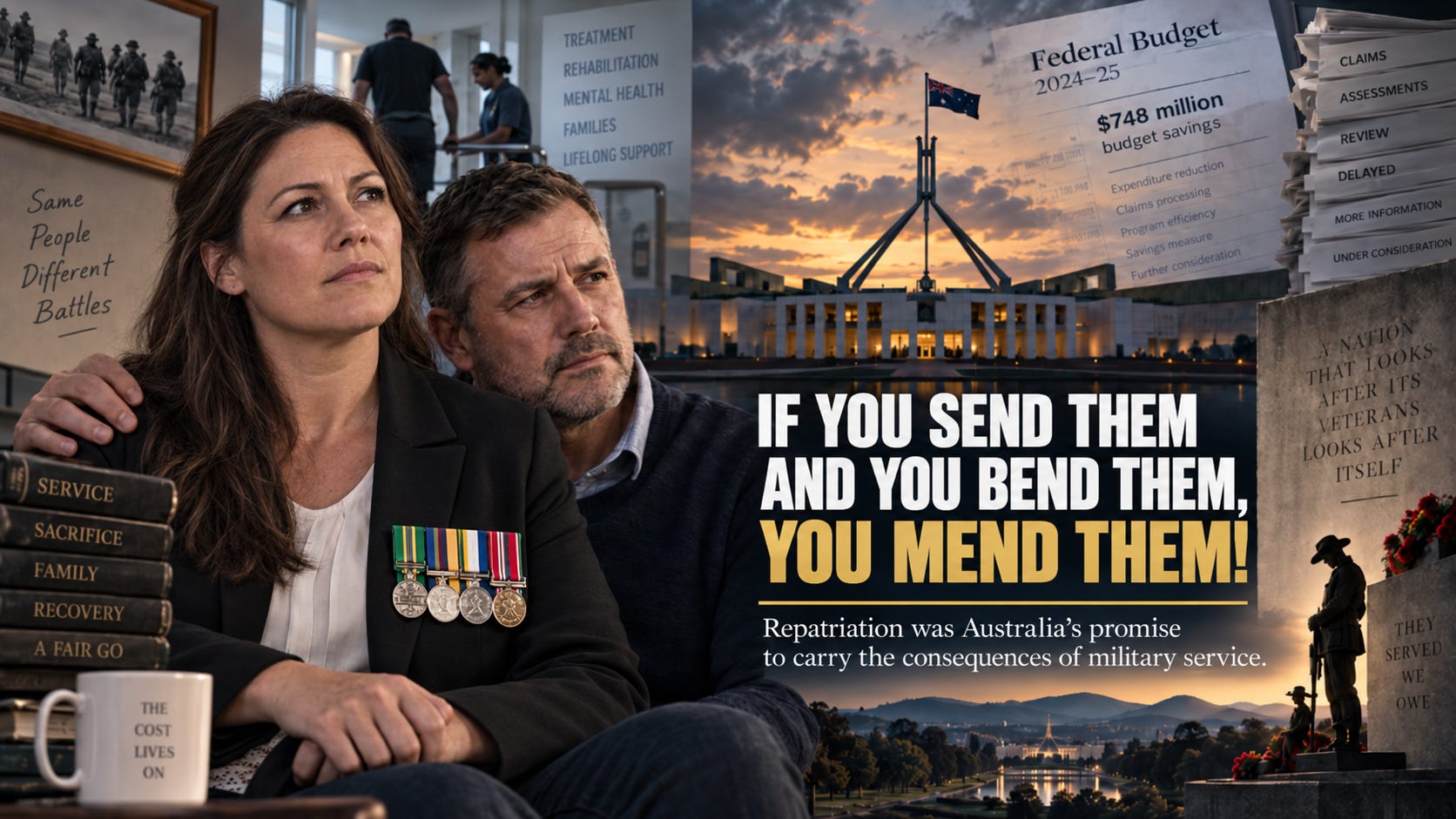
Repatriation in plain English: If you send them and you bend them, you mend them.
⸻
Repatriation was once Australia’s promise to carry the consequences of military service; today, too many veterans and families find that promise buried beneath claims, rules, reviews and budgets.
Most Australians probably hear “repatriation” and think it means bringing somebody home. After the First World War, Australia gave the word a much bigger meaning: care for people who came home wounded or sick, help rebuilding civilian lives, and support for families left carrying the loss.
Back in 1917, Prime Minister Billy Hughes told returned soldiers, “When you come back we will look after you”. Senator Edward Millen went straight to the heart of it, telling Parliament he was “not at this juncture concerned about finance” because Australia first had to face the duty it owed returned soldiers and then shoulder the cost.
My rule for Veterans’ Affairs says the same thing in eleven words: If you send them and you bend them, you mend them!
Repatriation started with what Australia owed, not with what a veteran could squeeze through a government process. Medical care, rehabilitation, compensation and help for families followed because military service had caused the harm. Rules and budgets still mattered, but they were there to help Australia keep the promise, not decide how much of the promise survived.
A century later, too many veterans meet the claim, the proof, the review and the DVA process before they ever feel the force of that promise.
Ian Lindgren from the Australian Veteran Community has come at the same problem from the claims side. In his piece published today, A Return to the Key Principle of the Repatriation System That Served the Veteran, his central point fits mine: veterans should not keep being made to prove an entitlement that flows from military service and has already been accepted.
Since 1 July, parts of the new Veterans’ Entitlements, Treatment and Support (VETS) reforms have moved in that direction. If DVA already accepted a condition under the old veterans laws, the veteran does not have to prove again that military service caused it. Another new rule lets DVA accept more than 150 recognised conditions when the basic tests are met, without making every veteran fight the same argument from scratch.
VETS shows that government can make the system carry more of the burden instead of pushing it back onto the veteran.
May’s 2026 Budget then showed the other side of the story. Albanese Labor put $169.7 million into higher allied-health fees while booking $748 million in savings over three years, followed by $340.2 million a year ongoing, from an Annual Monetary Limit on veterans’ allied-health services.
Veterans Minister Matt Keogh defended the $5,000 threshold and initially declined to meet veterans concerned about it. He later told Parliament he had “got it wrong”, before the Government scrapped the threshold on 17 September after weeks of pressure from veterans, advocates, Parliament and the media.
Political responsibility also reaches Prime Minister Anthony Albanese because the saving sat in his Government’s Budget and Keogh remains his Veterans’ Affairs Minister. ABC reported during the fight that the issue was being considered at the highest levels, including the Prime Minister’s office.
Australia still has a Repatriation Commission, and its role is not ceremonial. DVA says it oversees the veteran support system, deals with benefits and treatment, helps shape policy and advises government.
I can find no public account of what advice, if any, the Commission gave when veterans’ allied healthcare appeared in the Budget as a $748 million saving. Given the job DVA says the Commission does, veterans are entitled to know what role it played and whether anyone inside that machinery put the first principle of Repatriation on the table.
Inside Cabinet, the Expenditure Review Committee looks at proposals against the Government’s overall Budget strategy. Finance says it examines proposals against the Government’s fiscal strategy and advises Cabinet on spending priorities, but I can find no public rule that puts clinically necessary veterans’ care outside that search for savings.
Government cannot simply ignore a right the law gives a veteran, but governments can change laws and rules. When a change means government expects to spend less, the lower spend can become a Budget saving, which is exactly why the $748 million figure matters long after the $5,000 threshold itself has been scrapped.
Veterans Count belongs in the same argument because government can too easily see this community one file, one claim and one cost at a time. Veterans Count makes the people and issues visible electorate by electorate, while Repatriation reminds us what Australia owes veterans, war widows, families, carers and others carrying the consequences of military service.
Nobody is asking for blank cheques or a free pass for crooks. Chase fraud, chase dodgy providers and demand proper evidence, but do not make veterans keep winning back an obligation Australia has already accepted. Never start with a savings figure and work backwards to see how much veterans’ care can be made to fit inside it.
Australia does not need to rebuild the Repatriation system of 1917. We need to recover what Australians then understood: decide what we owe the men and women we send to serve, then write the laws, run DVA and build the Budget around keeping that promise, because if you send them and you bend them, you mend them!
Have successive Australian governments allowed claims, rules, reviews and budgets to bury the promise Repatriation was created to keep?
My writing stays free. If you’d like to help keep it going, you can support it here.