
Audio version narrated by an AI voice.
Need To Know
Inflation has reached 4.3 per cent, increasing the prospect of another rate rise on 3 November. Public expenditure adds to demand, while shortages of workers, housing and infrastructure limit how quickly supply can respond. The independent Reserve Bank of Australia (RBA) must account for those pressures, leaving governments answerable for their contribution to the conditions behind interest rate decisions.
———
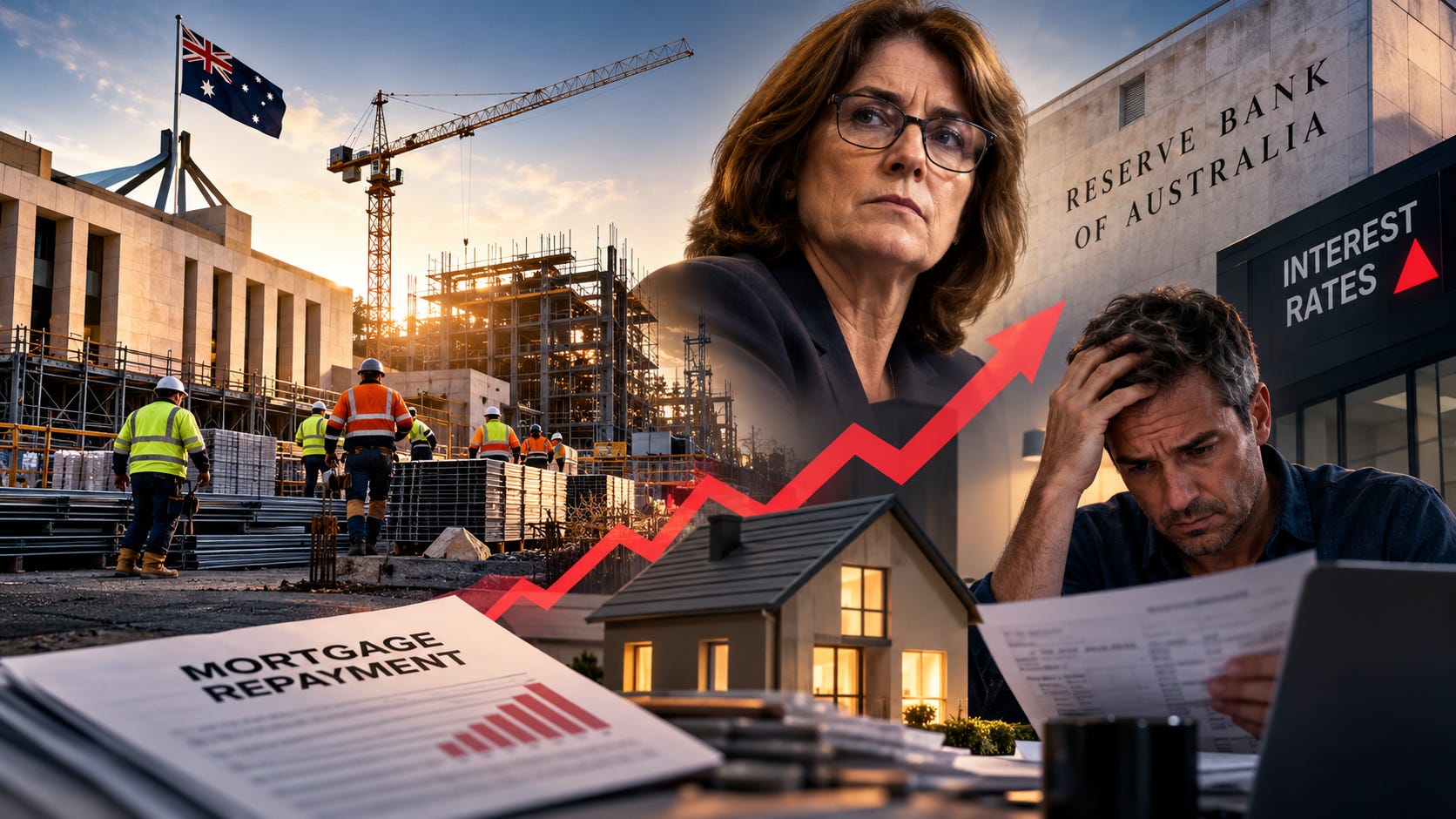
Government spending adds to inflationary pressure, while mortgage holders bear the cost of higher interest rates.
⸻
Reserve Bank Governor Michele Bullock has exposed an uncomfortable feature of economic management: government spending contributes to demand, but the RBA must manage the inflationary consequences independently.
Wednesday’s 4.3 per cent inflation figure has increased the prospect of another rate rise on 3 November. Mortgage holders know what that means: more money for repayments and less for everything else.
Bullock’s Senate Estimates appearance brings government expenditure into focus. Commonwealth and state governments determine their budgets, while the RBA must account for public demand when deciding monetary policy.
Government spending becomes inflationary when it adds demand to an economy already struggling to supply the workers, materials and services being purchased.
Consider a government infrastructure project competing with private builders for scarce electricians, engineers and materials. Contractors bid for the same limited resources, pushing costs higher across both sectors. Completed infrastructure may eventually improve productivity, but its immediate demand arrives before those benefits.
Higher government expenditure cannot immediately produce the additional workers and materials needed to prevent that competition from increasing costs.
When total demand exceeds available supply, the RBA can raise interest rates to discourage borrowing and spending. Its monetary policy mechanism works partly by reducing household disposable income and discouraging business investment.
A quarter-percentage-point increase on a $500,000 variable-rate mortgage initially adds approximately $1,250 in annual interest, assuming full pass-through and an unchanged balance. Borrowers may not have caused the inflationary pressure, but their spending is deliberately restrained. Businesses and workers also experience the effects through investment and employment.
Government expenditure is not the only source of inflation, and Bullock’s acknowledgement does not establish how much lower rates might otherwise be.
Housing and energy shortages also matter. Planning delays and construction constraints limit new homes, while electricity costs reflect supply, networks and investment. Higher interest rates cannot directly remove those obstacles.
My writing stays free. If you’d like to help keep it going, you can chip in here.
Nor should governments abandon worthwhile infrastructure. Spending can increase demand today while expanding productive capacity tomorrow, making timing and purpose important.
Fiscal policy involves more than expenditure totals. Taxation, transfers and subsidies influence demand differently, and the RBA’s August assessment found recent Commonwealth and state budgets had not materially changed its forecasts for public demand.
Government accountability should extend beyond budget balances to the economic consequences of spending decisions.
Even returning inflation to target would not restore earlier prices. Households still need incomes that recover purchasing power and more affordable essential services.
I support the RBA’s independence, but governments must account for the demand their spending creates and the supply constraints their policies influence. Australians facing higher borrowing costs deserve to understand both sides of that equation.
Should governments explain the inflationary effects of their spending decisions as clearly as the RBA explains interest rates?