
Audio version narrated by an AI voice.
Need To Know
Blind surfer Steve Fox uses smart glasses to read signs, understand what is around him and call for help when he is lost. Covert recording is a real privacy problem, but a ban aimed at the device can also hit people using the same technology to live more independently. Attorney-General Michelle Rowland has put another approach on the table: identify the harm, hear from disability users and avoid writing a new rule every time technology changes.
———
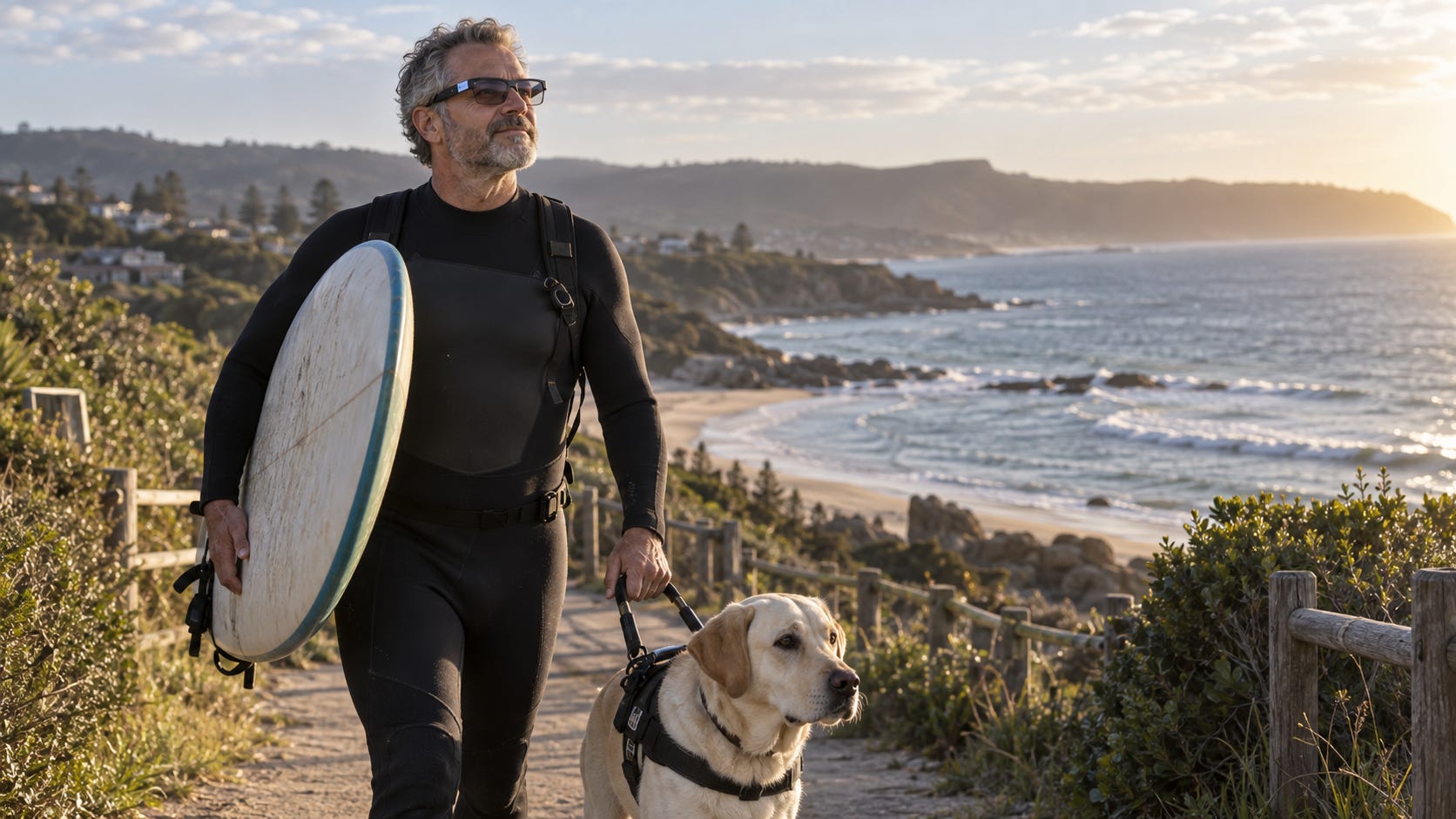
AI-generated illustration. The person shown is not Steve Fox.
⸻
Listening to Melinda James on ABC Illawarra Breakfast this week, I heard blind surfer Steve Fox explain how a pair of smart glasses once helped his wife guide him home when he became disoriented while walking with his guide dog.
I have never met Steve and I have not spoken to him, so I know only what he told Melinda on air and what has been publicly reported about him. He said a video call through the glasses let his wife see his surroundings, work out where he was and talk him back to where he wanted to go.
ABC reported last month that Steve is 60, lives in Gerringong, was diagnosed with retinitis pigmentosa as a child and lost his sight completely about a decade ago. He is also a national para surfing champion who has kept surfing by learning to read the ocean through sound, movement and feel.
Steve’s story makes the easy smart-glasses panic much harder to sustain because the device being treated as a privacy threat is also part of how a blind man reads and moves through the world.
People I describe as the “freedom fighters for the oppressed” have a familiar reflex: ban first, feel virtuous about it, and think later. Too often later never arrives. Smart glasses are a perfect test because it is easy to imagine what a creep might do with them and never bother to understand what somebody like Steve can do with exactly the same device.
Covert filming remains a genuine privacy harm because smart glasses can let someone record without the obvious social signal of lifting a phone and pointing a camera.
Smart glasses therefore create a real problem for pools, change rooms and other places where people reasonably expect more privacy. Wollongong councillor Dan Hayes told ABC Illawarra that council staff are already looking at signage, legal issues, enforcement and how to balance privacy with access for people with disability.
Canterbury-Bankstown has already gone further, banning smart glasses from council pools and leisure centres while allowing people who need them for accessibility to enter if they seek permission first. The Greens have proposed a 12-month import ban on camera-enabled wearable devices, with an exemption for genuine disability aids, while privacy laws are strengthened. Those responses show how quickly a real concern about misuse can become a rule about the hardware itself.
Attorney-General Michelle Rowland has taken a different federal position: no current import ban, explicit recognition of disability voices, and privacy rules she says should remain technology-neutral and principles-based.
Rowland told ABC News Breakfast that Vision Australia and other advocates had described the technology as “game changing”, and said their voices needed to be part of the debate. She also warned against governments playing “whack a mole” with each new wearable device, arguing instead for privacy rules designed to survive whatever comes next. Her full ABC News Breakfast interview transcript is here
Strip away the political labels and that is the machinery worth understanding. A ban feels decisive because it acts on the thing everyone can see, while rules aimed at misuse have to deal with intent, context, evidence and enforcement.
Once the glasses themselves become the target, exemptions have to be bolted back on for people who were never the problem. Someone then has to decide who qualifies, whether permission is needed and what staff should do when a wearer says the glasses are an accessibility aid. Canterbury-Bankstown’s rule already places that burden at the door by requiring accessibility users to seek permission first.
Steve himself pushed back on one suggested workaround when Melinda raised the idea of visually impaired wearers using badges. He said he did not want to wear a badge and asked whether everybody wearing sunglasses should suddenly need a label.
Phones show why the issue cannot be reduced to cameras being good or bad. Australians already carry powerful cameras everywhere, while smart glasses change the risk because other people may not know when recording has started.
Rowland’s approach does not make those privacy problems disappear, and she has also praised councils and businesses that impose restrictions in sensitive places. Her argument is narrower: address the harm in a way that does not assume today’s device is the last version of the technology. She explained that approach in detail on ABC News Breakfast.
My earlier Australia’s Nanny State Thinks It Knows Better piece argued that government should show the harm, explain why existing law cannot deal with it and make the smallest intervention needed. Steve’s story gives that principle a human test because a rule written to stop creeps can also land on a blind surfer using the same gadget to read a bus stop or find his way home.
Anyone calling for bans is entitled to make the case, but freedom is a poor slogan if it disappears the moment a new technology makes us uncomfortable. Before reaching for prohibition, the minimum intellectual duty is to understand both the harm and the good, then decide whether the proposed rule actually addresses the conduct causing the harm.
Before you decide whether smart glasses should be banned, did you know people like Steve were already using them this way?