

Audio version narrated by an AI voice.
Need To Know
Albanese Labor forecast $748 million in savings from a proposed $5,000 annual allied health threshold before withdrawing the measure. Additional clinically necessary treatment was supposed to remain available, yet the published Budget material doesn’t explain precisely which expenditure was expected to disappear. With senior DVA officials appearing before a Senate inquiry on Friday 30 October, the financial modelling deserves examination.
———
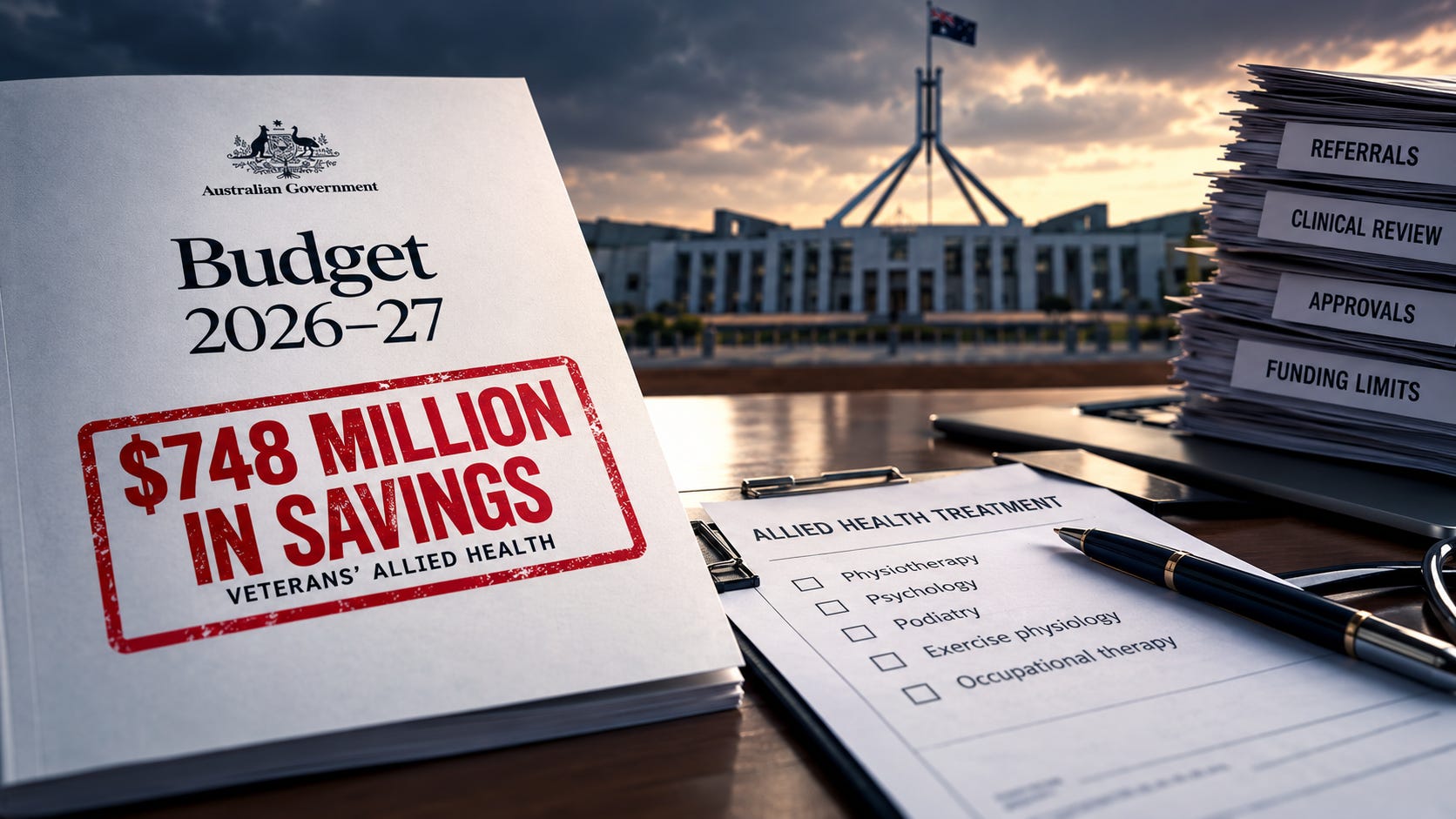
The $748 million savings forecast raises a simple question: what treatment was the Government expecting to spend less on?
⸻
Albanese Labor put $748 million in projected savings from the veterans portfolio into its 2026–27 Budget before the proposed changes to veterans’ allied health treatment had been settled.
That figure deserves closer attention, particularly with an inquiry by the Senate Foreign Affairs, Defence and Trade References Committee examining financial, numerical and administrative restrictions on healthcare funded by the Department of Veterans’ Affairs (DVA).
On the surface, the proposal sounded reasonable. Fewer GP referrals, less paperwork and greater scrutiny of unusually high treatment expenditure.
But how does a simpler system produce almost three-quarters of a billion dollars in savings while continuing to fund clinically necessary care?
Budget papers forecast $748 million over three years from 2027–28 through a proposed $5,000 annual allied health threshold. Another $30.1 million was expected from simplifying referral requirements. Those were separate projections, not evidence that $748 million worth of unnecessary treatment had been identified.
Before considering where the money might have gone, it’s worth understanding the arrangements the proposal was intended to replace.
Under DVA’s existing allied health treatment cycle, referrals generally expire after twelve sessions or twelve months, whichever comes first. Further clinically necessary treatment is permitted, but the veteran’s usual general practitioner (GP) must ordinarily issue another referral.
Someone receiving physiotherapy for a permanent service-related injury might attend every week simply to maintain mobility. After twelve appointments, another GP visit can be necessary even when treatment remains effective and the condition hasn’t changed.
An allied health practitioner also prepares an End of Cycle Report for the GP. DVA pays for that report but doesn’t routinely receive a copy, leaving the Department to demonstrate through other evidence whether the reporting requirement actually improves care.
Regular clinical oversight makes sense. Yet an administrative checkpoint isn’t automatically a clinically meaningful one.
My writing stays free. If you’d like to help keep it going, you can chip in here.
DVA already recognises that problem. Reports may be prepared after eight sessions when treatment is frequent or GP access is difficult, while veterans holding a Totally and Permanently Incapacitated (TPI) Gold Card are exempt from the cycle for physiotherapy and exercise physiology.
Eligible veterans with more complex needs can also receive tailored referral arrangements through DVA’s At Risk Client Framework. Existing safeguards are useful, but Parliament should establish whether they prevent interruptions in practice.
Submissions from DVA (17) and the Australian Medical Association (23) defend clinical review and GP coordination. Allied Health Professions Australia (22) and the Australian Physiotherapy Association (27) question the administrative burden and whether fixed checkpoints adequately reflect individual treatment needs.
Neither side is arguing that ineffective treatment should continue indefinitely. Their disagreement concerns how useful oversight should be organised without unnecessarily interrupting care.
Albanese Labor’s proposed replacement would have moved the checkpoint from twelve sessions to $5,000 in annual expenditure. By August, consultation material also contemplated exemptions for eligible TPI and Special Rate Disability Pension recipients and catastrophically injured veterans, with treatment continuing while additional funding was considered.
Veterans’ Affairs Minister Matt Keogh announced the withdrawal of the threshold on 17 September. Planned increases to allied health provider fees remained, but the withdrawal left unanswered questions about the savings already forecast in the Budget.
My concern goes deeper than the figure itself. As the Parliamentary Budget Office explains, Cabinet’s Expenditure Review Committee (ERC) considers spending and savings proposals against the Government’s Budget priorities.
Fair enough for ordinary departmental expenditure. But veterans’ healthcare raises a different question: did DVA identify unnecessary treatment and calculate the savings, or was it expected to find savings to fit a predetermined funding envelope?
Publicly available material doesn’t establish what instructions the ERC gave DVA. That’s precisely why the modelling and underlying assumptions need examining.
I began researching this series before I became aware of the later inclusion of Geoffrey Shafran’s 86-page submission, numbered 35. His evidence introduces a useful comparison with dental funding, which was never subject to the proposed $5,000 allied health threshold.
Shafran examines DVA’s dental Schedules A, B and C, where different services attract different combinations of practitioner discretion, prior approval and monetary restrictions (submission 35, PDF pages 8–10).
His central proposal concerns the Biennial Monetary Limit on specified higher-cost restorative dental treatment. Instead of using that amount as an absolute funding ceiling for veterans subject to it, he proposes making it a threshold for enhanced scrutiny, including independent specialist review where appropriate (submission 35, PDF pages 69–74).
That’s an important distinction. A threshold asks whether unusually high expenditure is clinically justified; a ceiling can prevent further funding regardless of the strength of the clinical argument. Shafran’s proposal retains financial oversight rather than granting unrestricted treatment.
Across the inquiry, the mechanisms differ, but a common question emerges. Are financial controls identifying unnecessary expenditure, or can they also make genuinely necessary treatment harder to obtain?
My Repatriation argument remains simple: “If you send them, and you bend them, you mend them!” Safety, clinical effectiveness and action against improper billing matter, but government should budget to meet accepted clinical needs rather than let an expenditure target determine them.
With four senior DVA officials scheduled as the final witnesses before the Senate Foreign Affairs, Defence and Trade References Committee this Friday, 30 October, senators have an opportunity to demand answers. I’d like DVA required to provide the modelling behind the $748 million forecast, on notice if necessary, including assumptions about treatment expected to continue, expenditure expected to fall and safeguards for clinically necessary care.
Senators should also seek evidence about treatment-cycle outcomes, interruptions caused by referrals or approvals, and care left unfunded when monetary restrictions apply.
For established clinically necessary treatment requiring separate DVA financial renewal, I favour interim continuity where a complete, timely application remains undecided, subject to documented clinical, safety and substantiated integrity exceptions. That’s a proposed protection, not automatic permanent approval or a replacement for ordinary GP referrals.
If the savings forecast was sound, the Department should be able to explain the calculations and their expected clinical consequences. Until then, $748 million remains a Budget projection, not proof of better healthcare.
If clinically necessary treatment was supposed to remain available, what should senators demand to see in DVA’s $748 million savings modelling? I’d be interested in your view.