

Audio version narrated by an AI voice.
Need To Know
DVA did not change AIHW’s numbers. It led with generally declining suicide rates while leaving 1,907 deaths, the 2.7-times rate after medical separation and the warning that the newest figures are not final out of its short public account. The deeper question is why the Royal Commission wanted AIHW and the National Suicide Prevention Office funded directly for this work, while the Government’s new $29.8 million package still gives DVA the biggest single allocation and its own tracker still says Recommendation 107 is “Note”.
———
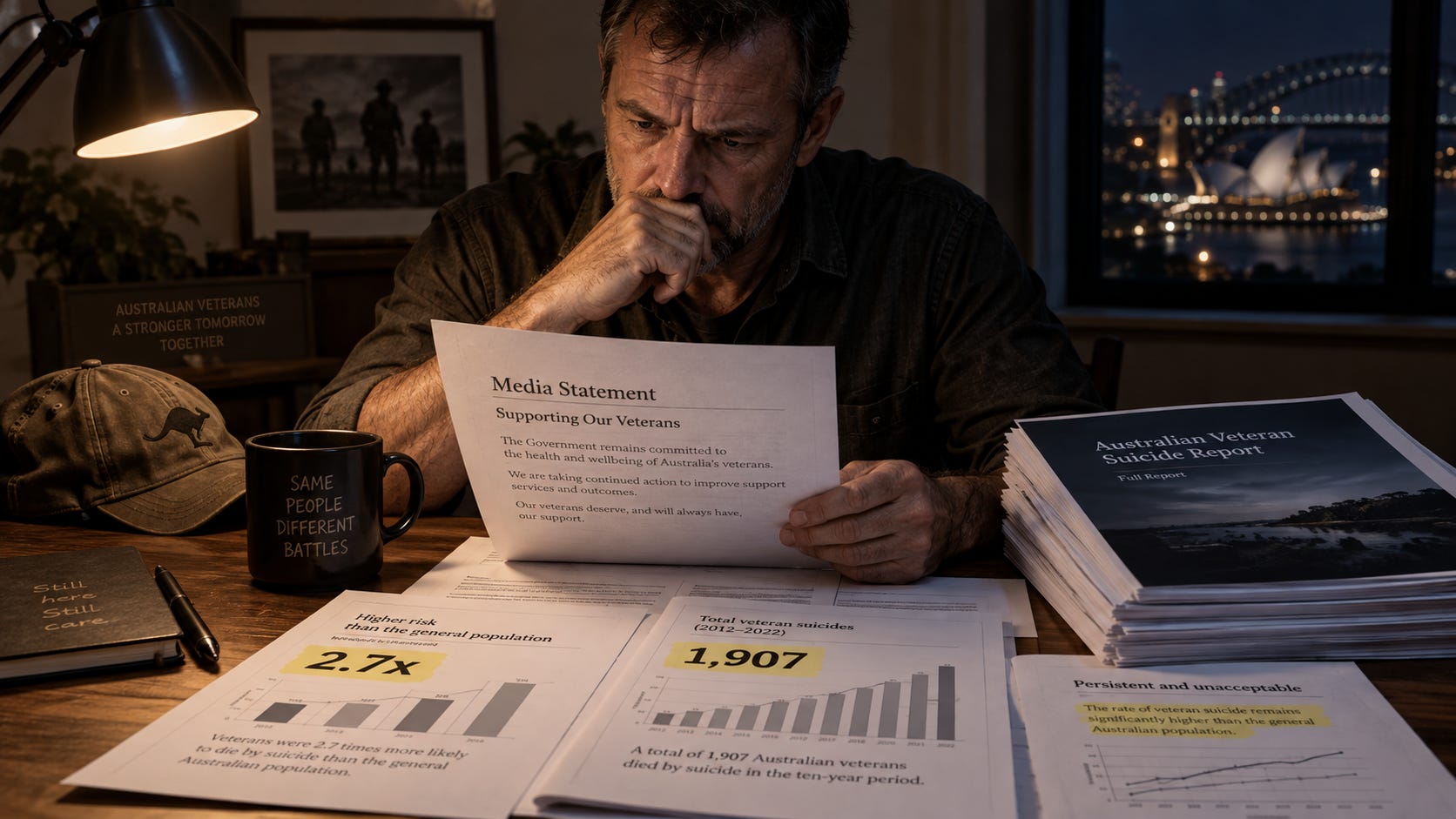
DVA led with the decline, but the full report told a much harder story.
⸻
Fellow veteran Andrea shared some compelling material with me today, and once I put the Department of Veterans’ Affairs (DVA) story beside the Australian Institute of Health and Welfare (AIHW) report, I stopped reading the headline and started following what had been left underneath it.
DVA’s 22 September story led with suicide rates among ex-serving men and women having “generally declined”, which AIHW does report. Open the full AIHW report and you also find 1,907 suicide deaths among serving and ex-serving Australian Defence Force (ADF) members from 1997 to 2024, including 1,592 people who had already left the ADF, while ex-serving men had a suicide rate 24 per cent higher than Australian men and ex-serving women 92 per cent higher than Australian women.
AIHW is an independent statutory Australian Government agency, and nothing I have read gives me any reason to question the integrity of its work. DVA and the Department of Defence jointly commissioned this year’s report, AIHW published the findings, and DVA put out its own much shorter version on release day, while the Department of Defence, despite jointly commissioning it, has yet to put its head above the parapet with a public statement of its own that I can find; its current suicide-prevention page still points to the 2025 AIHW report.
DVA did not change the numbers, but it did choose which ones veterans and families were most likely to see first.
One number stopped me cold: men who left the ADF voluntarily had a suicide rate similar to Australian men, while medically separated men had 2.7 times their suicide rate and men discharged because retention was not in the service interest had 2.5 times the voluntary rate. Earlier AIHW work found that 93 per cent of medically discharged men and 92 per cent of medically discharged women were DVA clients, compared with 40 per cent and 34 per cent of those who left voluntarily. Volume 5 of the Royal Commission’s final report then takes us straight into transition, DVA entitlements and claims processing, because the people carrying some of the greatest risk are also the people most likely to be dealing with the veteran system when they are at their most vulnerable.
Recent suicide figures also need an asterisk beside the word “decline” because the newest numbers are not all finished yet.
AIHW says the figures are final to 2021, revised for 2022 and preliminary for 2023 and 2024, because coronial findings and later Australian Bureau of Statistics updates can still change how some deaths are recorded. Its technical notes show this year’s report added another 11 suicide deaths to earlier years, so a fall can be real and still need the warning sitting beside it rather than several clicks deeper for someone determined enough to find it.
Then I got to Recommendation 107, and suddenly the money mattered. The Royal Commission did not simply ask government to build another database; it wanted AIHW and the National Suicide Prevention Office funded directly to build the National Veterans’ Data Asset and publish the yearly reports, which in plain English means giving the people doing the measuring their own funding rather than leaving DVA to commission the work used to judge the system. Albanese Labor says its $29.8 million package directly implements Recommendation 107, yet DVA gets the biggest single allocation at $12.9 million, AIHW gets $6.8 million, the National Suicide Prevention Office meets its costs from existing resources, and the Government’s own recommendation tracker still says “Note”, so I want to know how that squares with what the Royal Commission actually asked for.
Repatriation reform should not require veterans to become amateur auditors just to find out what the full suicide report says, how firm the newest numbers really are and whether the independence the Royal Commission asked for has actually been delivered.
We need Repatriation reform, and it will not come if people like you and me stay silent. Add your count to Veterans Count and tell us your connection to Navy, Army or Air Force, past or present, whether through service, family, caring, support, clinical work or another connection, and which issues need attention. Already counted? Send Veterans Count to five new people. One veteran is easy to ignore. An electorate is not.
If this subject sits heavily with you, Open Arms is available 24/7 on 1800 011 046. Lifeline is 13 11 14. In an emergency, call 000.
My writing stays free. If you’d like to help keep it going, you can support it here.