Crushing Illegal E-Bikes Will Not Clear Up The Confusion
NSW has strengthened police powers, but families still need a clear legal line before the wrong machine reaches the street.

NEED TO KNOW
Police in New South Wales (NSW) will soon have stronger powers over illegal e-bikes, but the buyer-confusion problem remains. The new law deals with unlawful devices once they reach NSW streets, footpaths and shared paths, while sale, labelling, border and national market rules still leave ordinary families exposed. Stronger enforcement is welcome, but governments still need to make the legal line clear before the wrong machine is bought, carried into NSW, or discovered during a police stop.
———
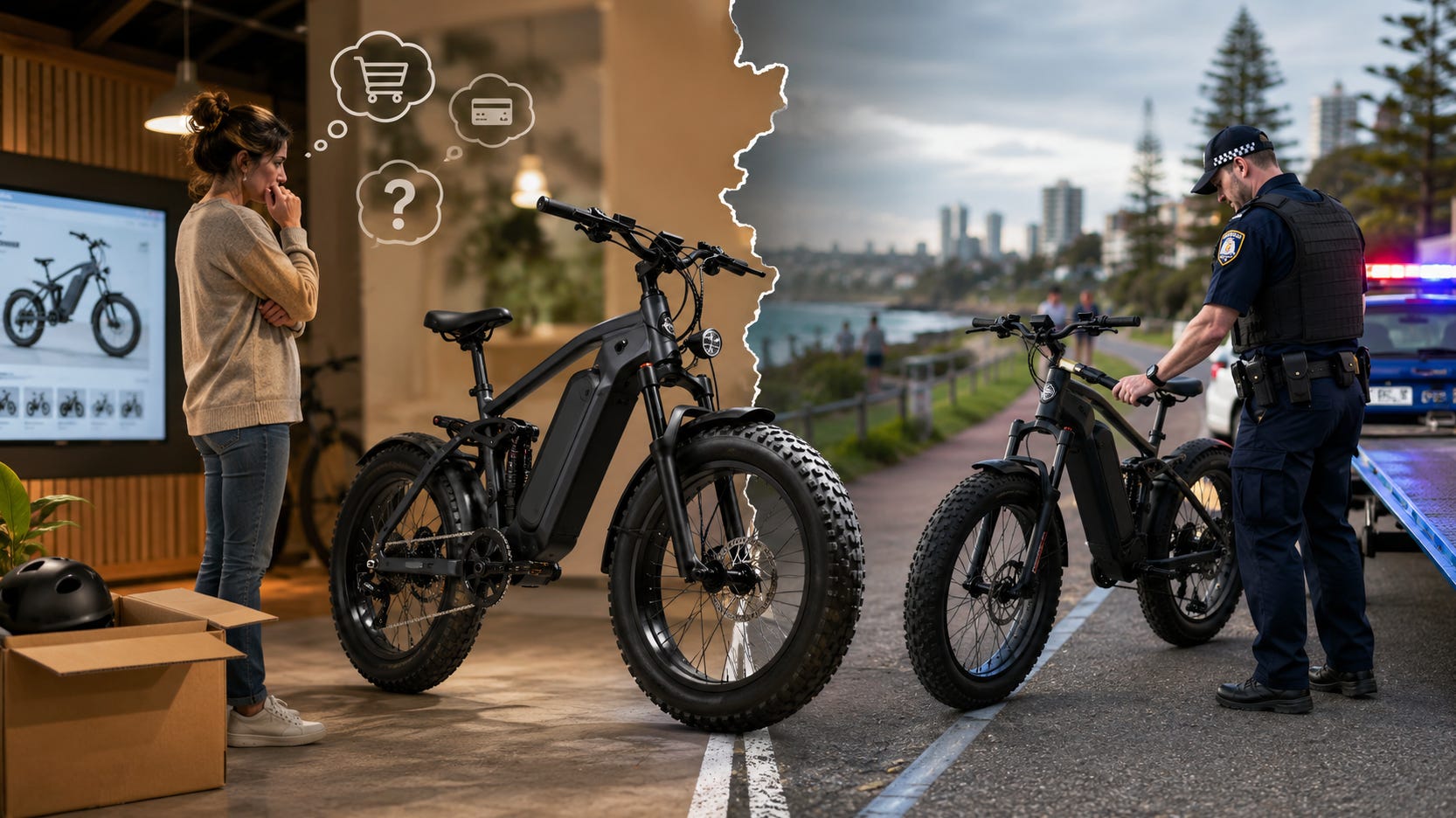
The new NSW e-bike crackdown may make illegal machines easier to seize, but it still leaves too many buyers guessing before the law catches up with the bike.
⸻
Stronger enforcement will help NSW deal with dangerous and overpowered e-bikes on the street, but it still leaves too many buyers guessing at the point of sale.
NSW Parliament this week passed the Road Transport Amendment (Non-registrable Motor Vehicles) Bill 2026, which now awaits formal Royal Assent from State Governor Margaret Beazley. Once the law commences, NSW Police and transport officers will have stronger powers to seize illegal e-bikes and similar machines from roads, footpaths, shared paths and public places.
Parents can see the problem in the shop window, the online listing and the teenager riding something that looks half bicycle and half motorbike. Pedestrians feel it when a heavy, fast machine flashes past on a coastal path, city street or suburban footpath while the legal explanation still turns on watts, throttles, speed cut-offs and classifications most people never read.
A crackdown after confusion is not the same as clear law before purchase.
In Legal to Buy. Illegal to Ride., I made the first point: the trap sits between buying and riding, because a device can look like ordinary transport while the law treats it as something else. My piece Albanese Must Put E-Bikes on the National Cabinet Agenda made the second point: e-bikes sit across Commonwealth import and product rules, state road rules and local enforcement. NSW has now strengthened its enforcement end of that system, but the rest still leaves too much work to police, parents, retailers, online sellers and guesswork.
Cross-border movement exposes the gap because a device does not become clearer just because a family, tourist or rider crosses into NSW.
Australia has a national market for these machines, but it still has state and territory rules for how many of them can be used in public. A device can be bought, marketed, packed in a car, carried into NSW or ridden near a border while the legal story changes around it, which is exactly why the issue was never just a local policing problem.
Families may welcome seizure and crushing powers when hoons are tearing through shared paths, because dangerous riding is not a minor nuisance. Parents will be far less forgiving if they discover their own purchase was a legal mistake hidden behind sales language, overseas specifications, throttle settings and fine print. NSW Police need the full force of the law behind them, but they should not be the first people translating technical rules into real life after the device is already on the street.
E-bike law will only feel serious when the rule book is as visible to buyers as the crackdown is to offenders.
Have you seen an e-bike or e-scooter sold, ridden or carried across borders in a way that made the rules feel unclear? Tell me what you have seen, because the gap between sales language and street enforcement is where this problem now lives.