
Audio version narrated by an AI voice.
Need To Know
Higher interest rates force households and businesses to cut spending, while governments decide whether to cut their own. Federal and state budgets can add to inflation, and announcing savings doesn’t necessarily mean less money is being spent. December’s budget update will reveal whether Albanese Labor is making genuine changes or simply announcing another impressive number.
———
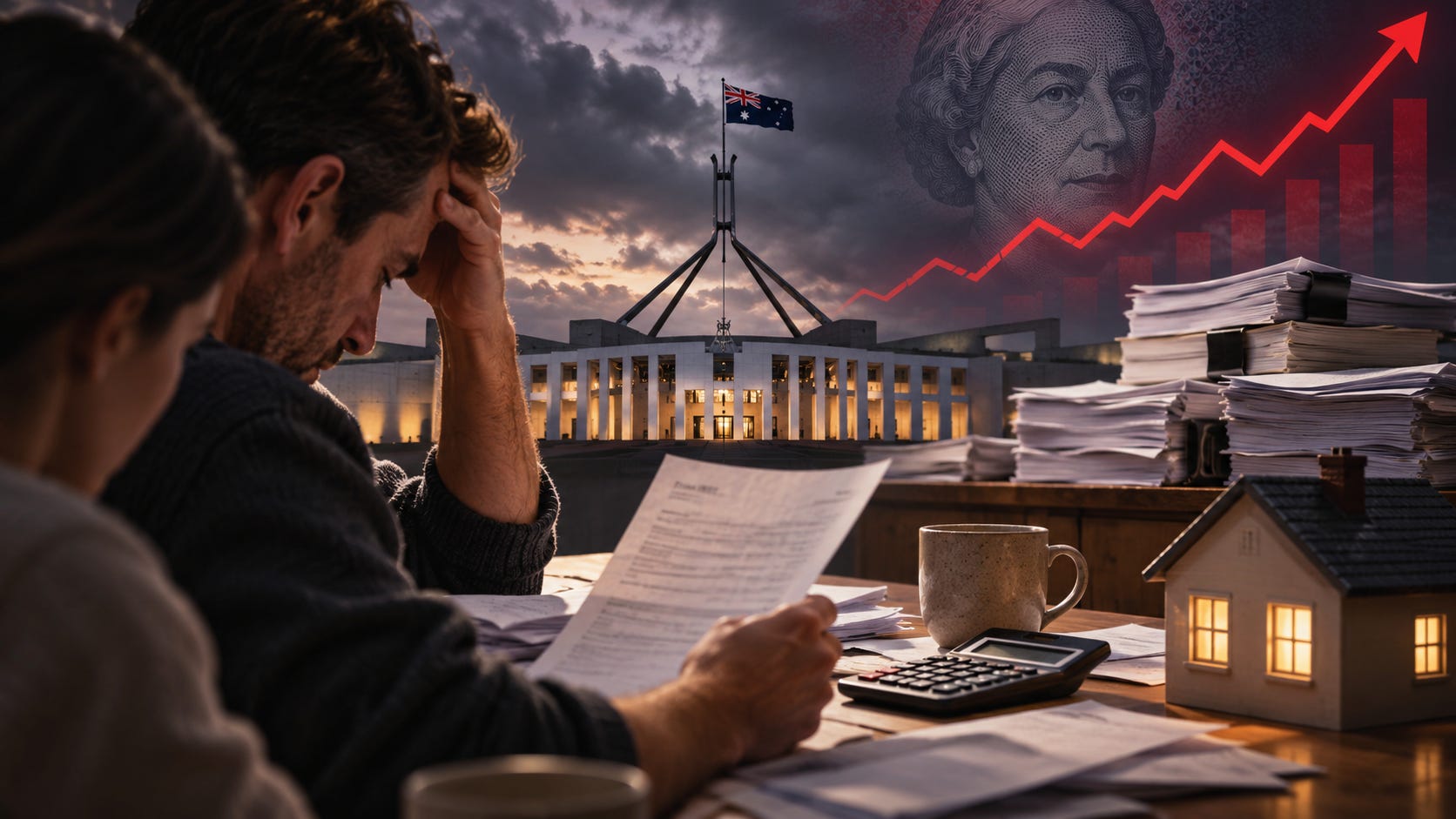
Government spending continues while Australian households are left to carry the cost of higher interest rates.
⸻
Mortgage holders don’t get to explain away their repayments with a carefully worded media release.
Today’s decision by the Reserve Bank of Australia (RBA) lifted interest rates another quarter-point to 4.85 per cent. According to Canstar, someone with a $600,000 mortgage could now be paying another $456 every month because of this year’s five increases. That’s nearly $5,500 a year in after-tax income, assuming the banks pass on the increases.
Treasurer Jim Chalmers told reporters: “Our budgets are not what’s putting upward pressure on inflation.” Yet his official statement said government budgets were not the primary cause of rising prices.
Government spin is a well-practised dark art. A carefully chosen qualification in one statement becomes a much broader claim in another. Not being the main cause of inflation is very different from not contributing to it at all.
Chalmers’ wording matters because governments spend money in exactly the same economy as everyone else.
My writing stays free. If you’d like to help keep it going, you can chip in here.
Canberra and the states buy materials, build infrastructure, employ workers and pay for services. Businesses and households need many of those same resources. When there aren’t enough workers, materials or services to meet demand, prices can rise. Government spending isn’t automatically inflationary, but calling something essential doesn’t make its cost disappear.
Former RBA governor Philip Lowe said in September that government spending had been adding to demand and “putting upward pressure on inflation”. He argued Australia should be putting money aside rather than continuing to run large budget shortfalls.
Ross Gittins, economics editor of The Sydney Morning Herald, reached the issue from another direction. Gittins wants bigger government and better services, but says governments must raise enough revenue to pay for them. His concern is that government budgets can encourage spending while the RBA is trying to slow it.
Both are describing a problem Australians can readily understand. One part of government is trying to cool the economy while another can keep adding heat.
Federal spending isn’t the whole story, either. According to the Parliamentary Budget Office, governments across Australia expect to come up about $67 billion short of what they need to cover their planned spending and building work this financial year. States and territories account for $38 billion of that gap.
Put simply, governments are planning to spend more than they expect to bring in and will need to borrow to help cover the difference. That doesn’t prove how much inflation they’re causing. But it shows why looking at Albanese Chalmers Labor budget alone misses much of the picture.
Chalmers keeps pointing to government spending growing more slowly earlier this year. The RBA agrees it slowed, but its latest forecasts expect government demand to grow more strongly again by the middle of next year. Slowing down is not the same as stopping, although slower growth can help ease pressure.
RBA Governor Michele Bullock made the separation of responsibilities clear at today’s media conference:
“Independence is a two-way street. I don’t tell them what to do with fiscal policy. They don’t tell me what to do with interest rates.”
Bullock’s statement matters. She and the RBA board members decide interest rates independently. Governments decide their spending and taxation policies. When the RBA raises rates, borrowers feel the effect. Government projects don’t automatically stop.
Chalmers has also been promoting almost $180 billion in budget savings. But here’s something worth understanding. Governments often count savings against what they previously planned to spend, not what they spent last year.
Calling a smaller increase a saving doesn’t mean the bill has gone down.
Finance Minister Katy Gallagher was asked on ABC television today whether December’s budget update would deliver more savings than new spending. She wouldn’t commit. Gallagher defended moving money from less important programs to more important ones. That may be worthwhile, but moving money around isn’t necessarily the same as spending less overall.
Economist Chris Richardson estimates that cutting annual government spending by $7 billion to $10 billion could take roughly as much pressure off demand as a quarter-point interest rate increase. It wouldn’t guarantee an immediate rate cut, but it shows governments have choices beyond leaving the RBA to do the work.
Mortgage businessman Mark Bouris has been much more direct. Asked which government policy he would change, his answer was one word: “Spending.” He wants governments to examine everything and cut 20 per cent.
Bouris hasn’t explained exactly which services should disappear, and his mortgage business has an interest in refinancing. But his frustration reflects what borrowers are experiencing. Household spending is being squeezed while governments argue about whether their own spending is part of the problem.
Shane Wright, Nine Newspapers economics correspondent, argued today that the RBA has played its part and attention now needs to turn to Chalmers and the states.
Cutting government spending has consequences. Programs have supporters, projects have contractors, and communities expect promises to be kept. Raising taxes is equally unpopular. Politicians must defend those decisions, while an independent RBA can increase borrowing costs without Parliament cutting a single program.
Oil prices, private investment and weak productivity also contribute to inflation. Nobody can credibly attribute today’s rate rise entirely to government spending. But blaming overseas events doesn’t remove the effect of choices made here in Australia.
December’s budget update should answer three straightforward questions. What spending has actually been cut? What new spending has been approved? Are governments taking pressure off the economy, or simply announcing savings while the total bill keeps rising?
Australians can already see what higher interest rates are costing them. They deserve the same clarity about what their governments are doing.
Should federal and state governments have to show what they’ve actually cut, rather than simply announce billions in savings? Where would you start?