
Audio version narrated by an AI voice.
Need To Know
Britain’s Defence Secretary is now telling families to keep food, water and cash at home for disruption that could include terrorism and war. His warning is the public end of something much bigger involving Home Defence, revived War Books, critical infrastructure and households themselves. Australia is not Britain, but our AUKUS relationship and our own whole-of-nation defence policy make that shift worth understanding.
———
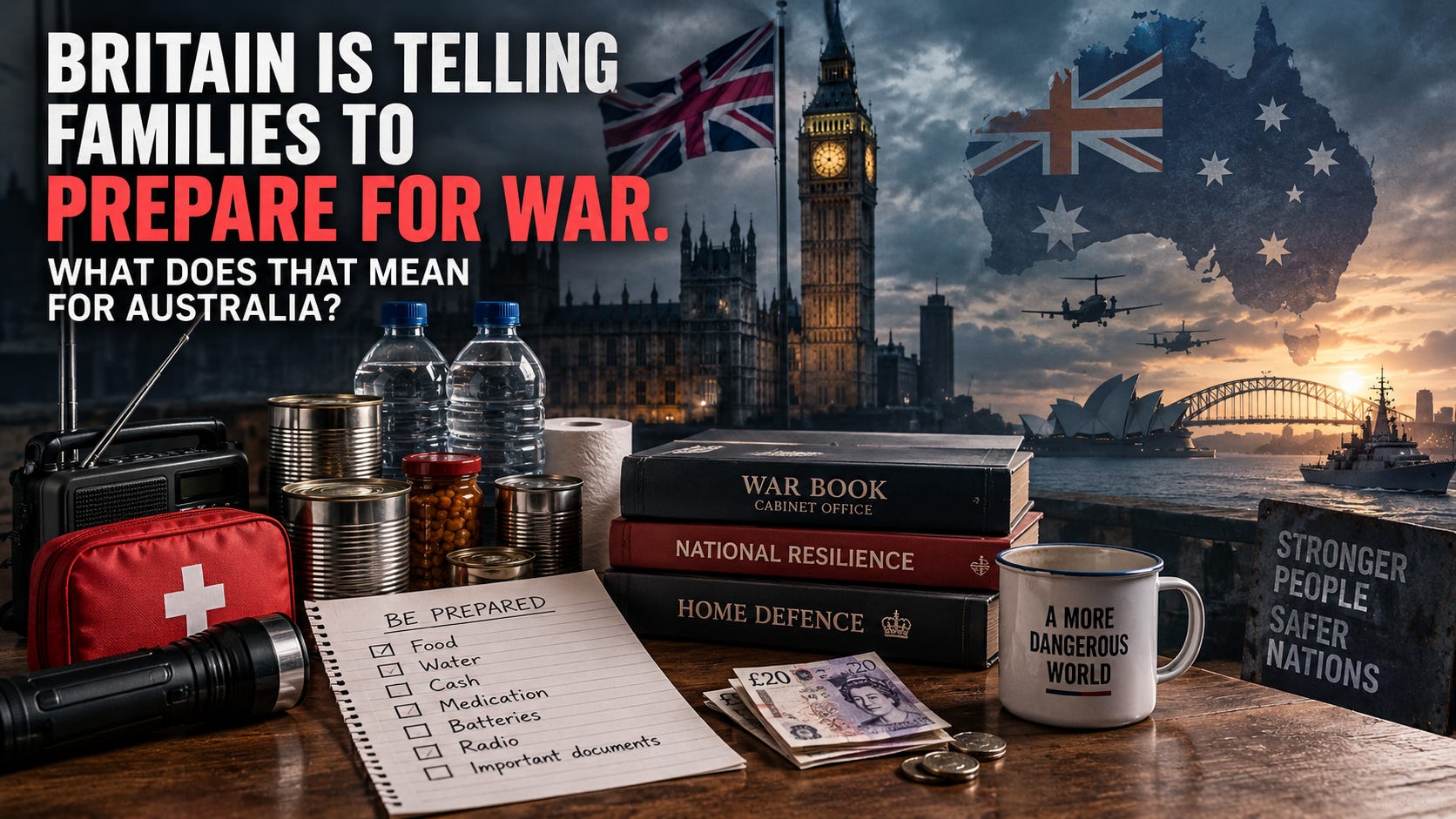
Britain is taking preparedness into the home as the threat of war moves closer to everyday life.
⸻
Something bothered me when I read The Independent today reporting that Britain’s Defence Secretary is telling families to keep cash, bottled water and tinned food at home for emergencies that could include war.
Food and bottled water were not what caught my attention because Britain has had emergency advice for years. Australians living with bushfires, floods and cyclones already understand the value of keeping enough supplies at home to get through a few bad days.
Timing bothered me because ABC Radio National was already reporting on 1 September that Britain wanted households to stockpile food amid extreme weather and threats from hostile states. Twenty-five days later, Britain’s Defence Secretary was personally telling families what to keep in the cupboard while talking about terrorism and war.
Britain did not suddenly discover during September that tinned food and bottled water are useful when the lights go out.
Defence Secretary Wes Streeting told The Sun on Sunday that families should keep cash, bottled water and tinned food available if electricity or online banking disappears. His examples ran from floods and wildfires through terrorism to extreme acts of war. Streeting also called for a “whole society approach” to national resilience while warning that Britain faces a greater risk of war than at any point in his lifetime.
Something else had clearly gathered pace during those 25 days, and the trail leads well beyond household emergency advice.
Britain’s 2026 Resilience Action Plan describes growing Russian attacks below the threshold of conventional war, major cyberattacks and a more dangerous and contested world. The British Government is accelerating Home Defence planning and reviving the War Books that tell departments how to respond to conflict and threats against the British mainland.
Preparations are also moving outside government, with executives responsible for critical infrastructure and defence companies being brought into closed-door briefings on the Russian threat. Ministers say Russia and its proxies use cyberattacks, sabotage and disinformation against organisations underpinning everyday British life. Government, industry and now households are being pulled into the same resilience system.
Britain’s September shift matters because preparation for conflict is no longer stopping at the doors of government departments, military headquarters or critical industries.
Australia came into my thinking early because our Government is already using remarkably similar language. Our 2026 National Defence Strategy calls for better national civil preparedness and national resilience as part of National Defence.
Events around RAF Fairford then gave Britain’s warnings an uncomfortable immediacy, with five men arrested near the airbase used by United States forces on suspicion of explosives offences and preparing a terrorist act. Counter Terrorism Policing says possible activity by people knowingly or unknowingly working for a foreign state is among several lines of inquiry.
Fairford did not cause Streeting’s warning because he made his remarks before the incident.
Police have not established that Russia, Iran or any other foreign government was responsible, and the investigation continues. Britain was already preparing for hostile-state disruption when an incident at a strategically important airbase made the environment behind those preparations feel considerably less theoretical. Joining those dots also changes what Streeting’s shopping list actually means.
Britain is not really asking families to stockpile food because it is asking them to stockpile time.
Imagine power fails across a large area while government is already dealing with whatever caused it. Phones go flat, electronic payments stop and supermarkets struggle to trade while hospitals, vulnerable people, damaged infrastructure and essential services compete for the same finite emergency resources.
A household capable of managing for three days gives government three days before that household needs help. Multiply that across millions of homes and food, water, medication, cash, batteries and reliable information stop being merely personal precautions. Prepared homes also make disruption less useful as a weapon because knocking out electricity, communications, banking or supplies creates less leverage when millions of households can absorb the first shock.
Suddenly the War Books and the baked beans belong in the same story because both are designed to keep Britain functioning when something tries to stop it.
Britain’s warning carries a historical echo for Australians because Prime Minister Robert Menzies told the nation in September 1939 that Britain had declared war on Germany and “as a result, Australia is also at war”. Australia is sovereign today and a British decision to go to war does not automatically put us at war.
Our modern connection is different but hardly distant. Australia and Britain are AUKUS partners with deep defence, intelligence, technology and military links.
Australia is also moving down its own preparedness road through Parliament’s inquiry into national civil preparedness and resilience. Its terms include essential goods and services during crisis or conflict and whole-of-nation support for National Defence. Most tellingly, Parliament is examining how to go about “activating and preparing the broader Australian community for contingencies”.
Britain’s threat assessment is not automatically Australia’s, and none of this means Australians should start preparing for a British war.
Britain calls its approach “whole society”, while Australia calls ours “whole-of-nation”. Britain has spent September showing what happens when those words stop being language in a defence document and start reaching ordinary homes.
One of our closest defence and intelligence partners has decided its security environment is serious enough to tell families what to keep in the cupboard. Australia has independently decided that national civil preparedness and resilience belong inside National Defence. Australia’s Parliament is now asking how the broader community should be prepared for contingencies.
Britain has started showing its people what “whole society” means at home, and its sudden change of tempo gives Australians a good reason to understand what “whole-of-nation” means for us.
When Australia talks about whole-of-nation defence, what should an ordinary Australian household actually be ready for?
My writing stays free. If you’d like to help keep it going, you can chip in here.
Should Australia have a national household preparedness standard?
Yes, 72 hours
Yes, seven days
Yes, longer than seven days
No national standard