Australia Has a Fuel Problem — This Series Explains It

TL;DR
The current fuel shock did not create Australia’s vulnerability. The conflict in the Middle East has simply exposed how quickly external pressure can hit a country that relies heavily on imported fuel and fragile supply chains. Australia’s real weakness sits inside the system that refines, stores, and moves fuel, not just in where supply comes from. This series sets out, in the eight pieces that follow, the fuel problem Australian politicians still refuse to confront directly.
———
⸻
The latest fuel shock did not create Australia’s problem.
Conflict in the Middle East has again shown how quickly fuel markets can tighten. Shipping routes, supply chains, and prices all come under pressure when instability spreads across a region central to global oil flows.
Australia feels that pressure quickly.
Australian reliance on imported refined fuel means overseas disruption moves straight through to domestic markets. Price spikes, shipping delays, and supply anxiety are not distant events when the system at home is already exposed.
That exposure is not new.
Australia’s fuel vulnerability existed before this crisis and will remain after it passes. The trigger changes, but the weakness stays in the same place. System fragility, not geopolitical novelty, is the real constant.
The system is the issue.
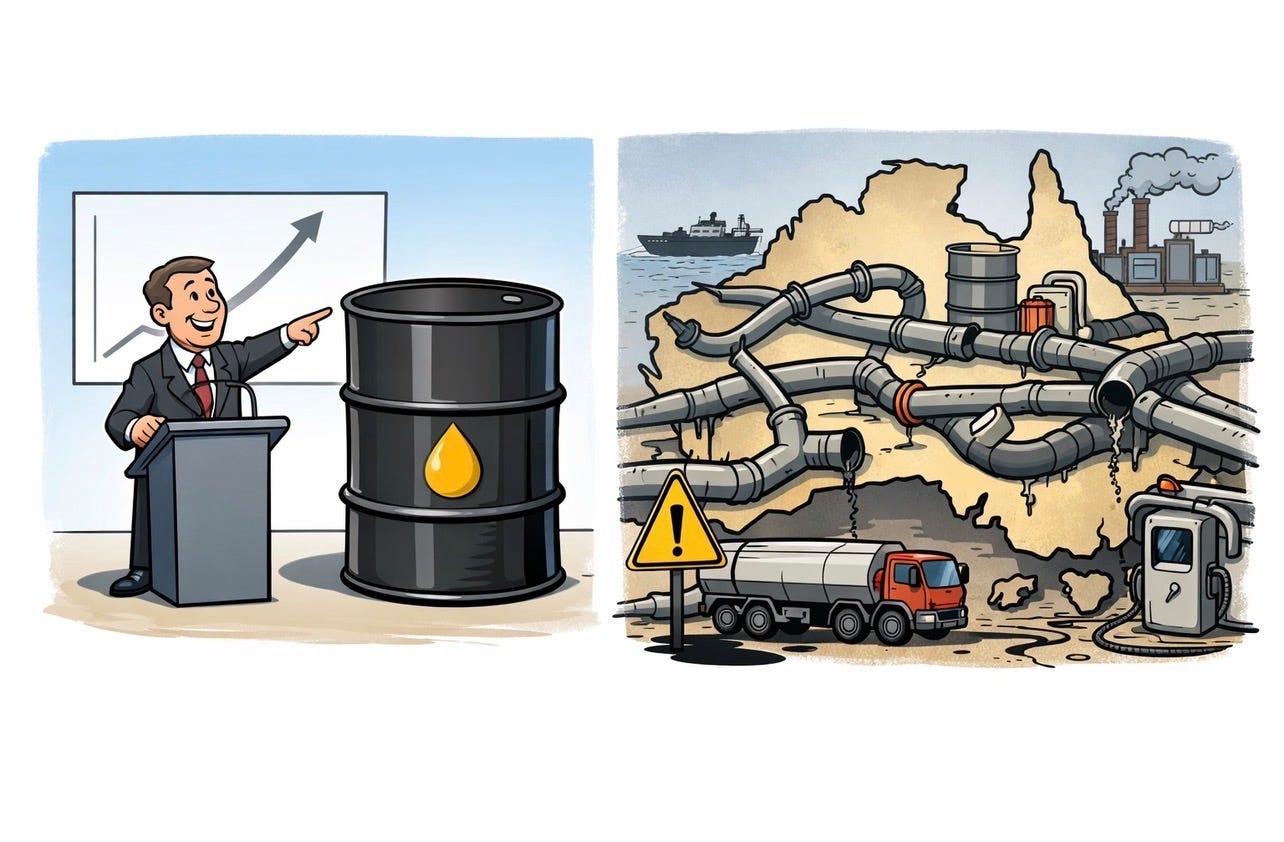
Fuel does not move directly from global supply to Australian users. Fuel moves through refining, storage, distribution, and allocation, and each stage creates a point of failure when conditions tighten. A country can have access to supply and still fail if the system cannot hold.
This series addresses that gap.
Each piece takes one part of the fuel problem and deals with it directly. The purpose is not to sell a slogan, but to separate what is achievable from what is fantasy.
Clarity is the starting point.
Australian debate is crowded with confident claims about self-sufficiency, production, sovereignty, and alternatives. Serious examination of refining, stockholding, logistics, and system control is much harder to find. That is the elephant in the room this series is designed to drag into the open.
The argument is not complicated. The argument is uncomfortable.
First in the series: Australia Cannot Be Fuel Self-Sufficient