

Audio version narrated by an AI voice.
Need To Know
DVA did not simply give up the Repatriation Hospitals and leave veterans to fend for themselves. The Commonwealth sold or transferred the hospitals, then paid states and Ramsay to keep treating veterans through a much wider hospital system. Veterans gained more places to receive care, but once government handed over the keys, the Repatriation promise depended on what it had written into the deals and what happened when somebody failed to deliver it.
———
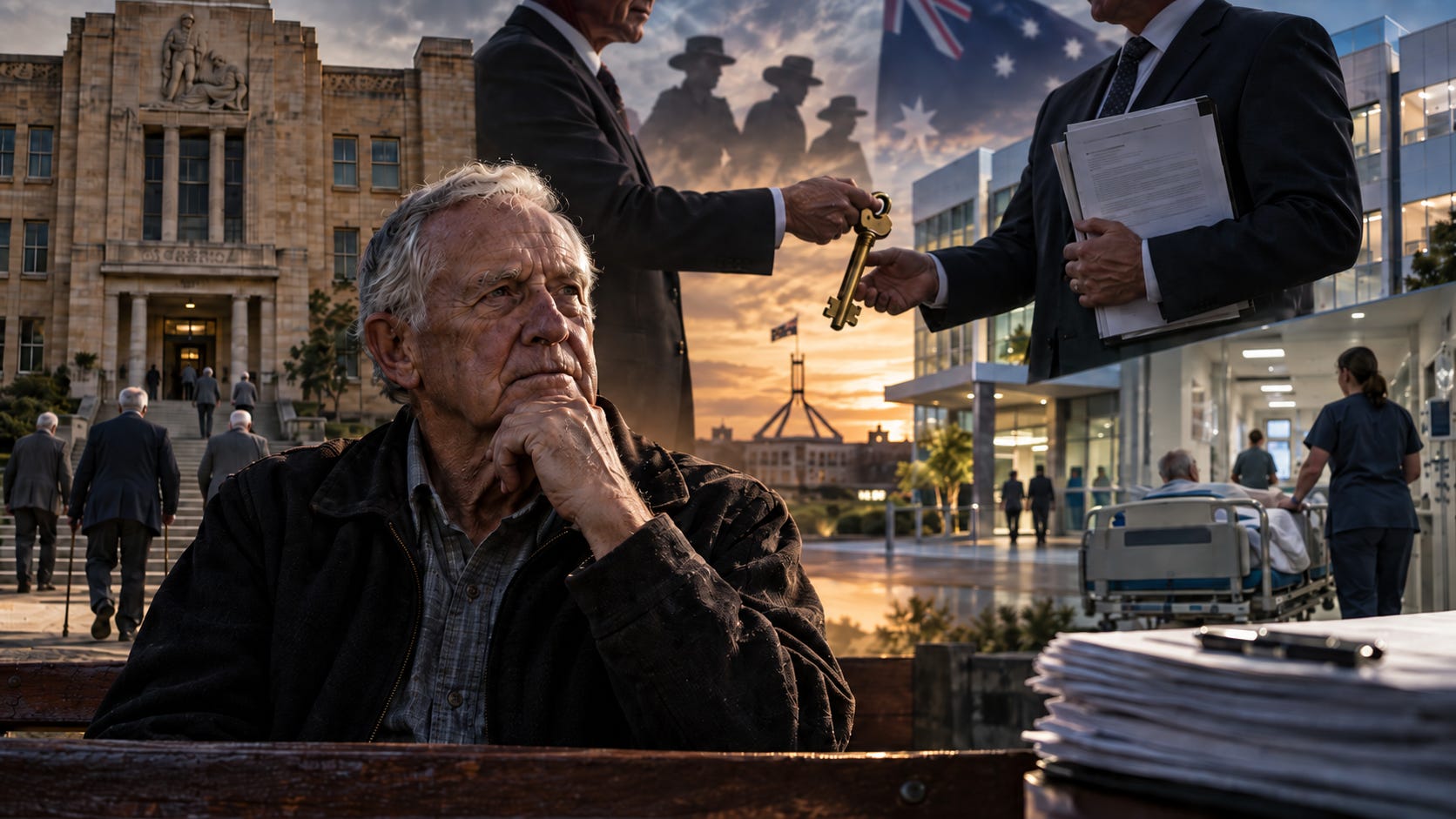
Government handed over the keys, but not the promise to veterans.
⸻
A few days ago I said I wanted to open the deals that replaced the Repatriation Hospitals, because recording the transfer of a building is easy while tracing the promise attached to it is much harder.
Start with what actually changed. Hobart, Concord, Heidelberg and Daw Park moved into state hospital systems, while Hollywood and Greenslopes were sold to Ramsay Health Care Group.
A 5 March 1997 Senate answer listing each Repat hospital transfer and sale said the program was expected to save the Budget about $1 billion over 10 years. Veteran care did not disappear when the Commonwealth signs came down, but the Department of Veterans’ Affairs (DVA) stopped owning the hospitals and started paying other people to provide the care.
DVA had changed from hospital owner to customer, and the veteran promise now had to survive outside institutions the Commonwealth controlled.
Hollywood and Greenslopes make the bargain easiest to understand. The Australian National Audit Office’s (ANAO) 1996–97 audit of the Hollywood and Greenslopes sales records $82.45 million in gross proceeds and says the long-term service contracts that accompanied them had an estimated nominal value of $775 million. ANAO split that contract value into $400 million for Hollywood and $375 million for Greenslopes.
Hollywood and Greenslopes were never just property sales because the veteran care the Commonwealth committed to buy was worth many times the gross proceeds from selling the hospitals.
Ramsay’s 1997 prospectus shows what government had to put in writing once it no longer owned the hospitals. Specified veteran services had to continue at Hollywood until 13 February 2006 and Greenslopes until 6 January 2006, backed by minimum quarterly Commonwealth payments.
ANAO’s section on Commonwealth risk exposure in the hospital-sale audit shows how seriously the contracts treated failure. Performance guarantees were required, veterans initially received preferential access to 120 beds at each hospital, quality standards could trigger damages, and pre-approved replacement operators could step in if the original operator defaulted.
Commonwealth government had swapped ownership for a contract, so the strength of that contract became part of the veteran healthcare promise.
Wider reform followed the same logic. ANAO’s 1998 audit of DVA hospital purchasing describes the Repatriation Private Patient Scheme, which opened access to public hospitals, former Repats and contracted private hospitals. Wider access was a real gain, especially for veterans living nowhere near a Repat.
Something valuable also went the other way. Commonwealth government surrendered direct control over hospitals, staff and the concentrations of veteran knowledge built inside institutions designed around veterans. A 2019 parliamentary inquiry into transition from the ADF captured both sides: DVA said the wider public and private system improved local access, while the committee found veterans had lost a service focused specifically on their needs and the expertise that focus had built.
Veterans gained a much bigger hospital map, but the Commonwealth no longer owned many of the hospitals carrying the promise.
DVA’s current hospital arrangements show how complete the change became. Agreements cover every state and territory public hospital system, alongside contracts with nearly 550 private hospitals and day procedure centres. A veteran can be treated in far more places, but the bed, staff and building may belong to an organisation DVA does not control.
Monitoring became part of the bargain. The Repatriation Commission’s private patient principles, reproduced in ANAO’s 1998 hospital-services audit, required it to monitor access to and quality of hospital care through a National Treatment Monitoring Committee and state and territory committees, with the national committee reporting back to the Commission and ultimately to Parliament.
Current DVA rules for contracted private hospitals still require annual quality reports and a nominated Veteran Liaison Officer. Those requirements can sound like bureaucracy until you remember what replaced the old system: DVA is paying for veteran care inside hospitals it does not own.
Strip away the machinery and the bargain becomes pretty simple. Veterans gained access to far more hospitals, but Commonwealth government gave up the direct control that came with owning the places providing their care. From then on, keeping the Repatriation promise depended on what government put in the contracts, how closely it watched what happened and whether it acted when the care fell short.
Repatriation reform has to make responsibility visible again, because changing who owns the hospital never changed who owes the veteran the promise.
If you received care through a Repat before or after these changes, tell me what got better and what was lost.
We need Repatriation reform, and it will not come if people like you and me stay silent. Add your count to Veterans Count and tell us your connection to Navy, Army or Air Force, past or present, whether through service, family, caring, support, clinical work or another connection, and which issues need attention. Already counted? Send Veterans Count to five new people. One veteran is easy to ignore. An electorate is not.
My writing stays free. If you’d like to help keep it going, you can support it here.