

Audio version narrated by an AI voice.
Need To Know
Australia has an extraordinary international reputation for creatures supposedly waiting to kill you. Australians mostly treat the same dangers as background noise because we grew up knowing what not to poke, pat, swim with or annoy. Perhaps we should not laugh too loudly, because every country has dangers the locals barely notice and, despite knowing all this, I still clicked.
———
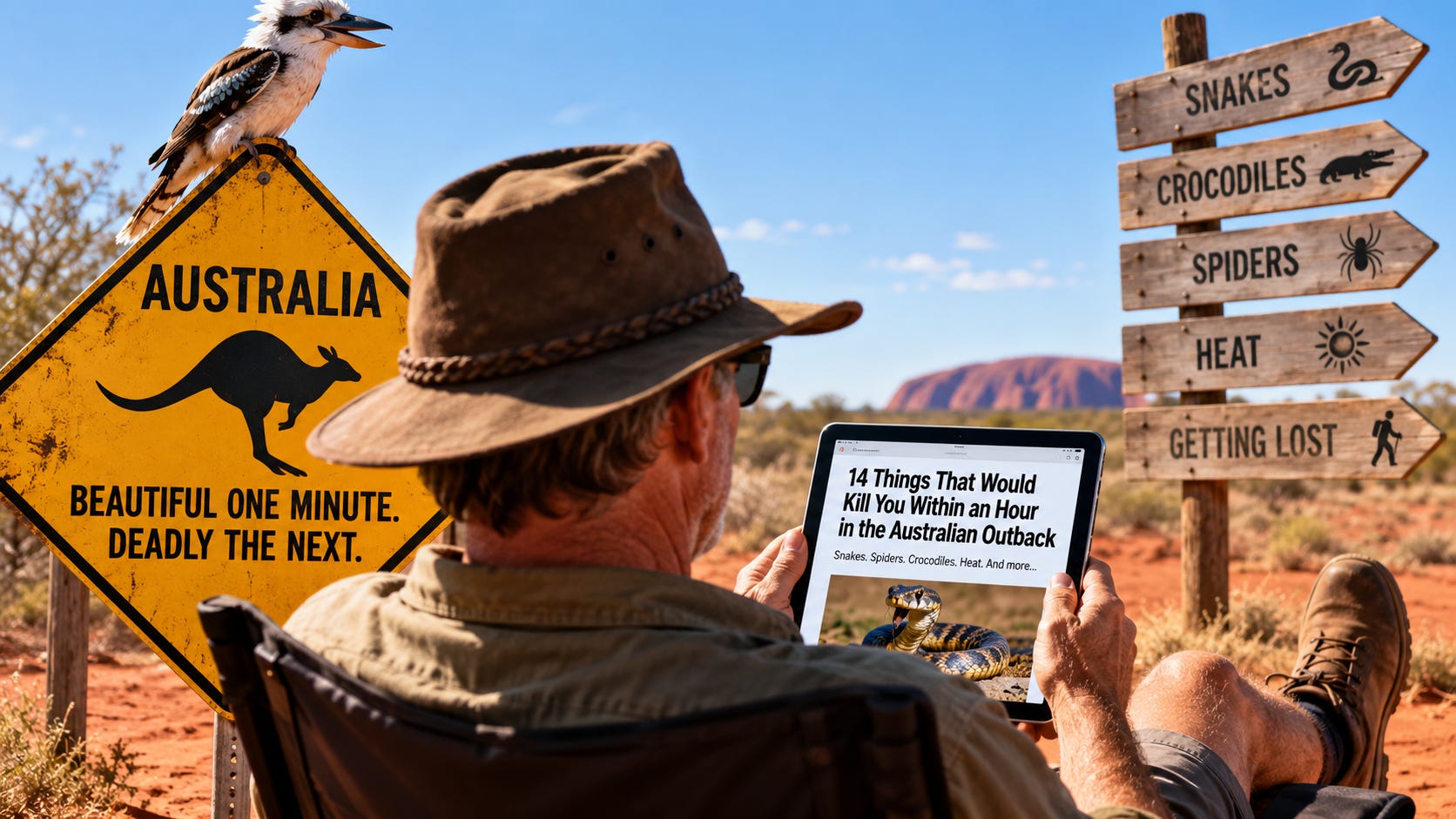
Australia’s deadly reputation is terrifying, irresistible and, as it turns out, bloody good clickbait.
⸻
A story popped up in my Flipboard feed promising 14 Things That Would Kill You Within an Hour in the Australian Outback, and naturally I bloody clicked it.
Somewhere along the way, Australia became the world’s favourite continental death trap. Visitors arrive primed for snakes, spiders, crocodiles and assorted venomous bastards, while most Australians wander around the supposedly lethal place without giving them much thought.
Soon I was scrolling past box jellyfish, blue-ringed octopuses, inland taipans and saltwater crocodiles before the list moved on to dehydration, heatstroke and getting lost. Frankly, the first half made Australia sound as though we’d assembled a committee and given every member a different way to kill tourists.
Australians aren’t fearless about this stuff; we’re familiar with it, and familiarity makes potentially terrifying things remarkably ordinary.
See a snake and leave the bloody thing alone; see a crocodile warning and don’t swim there; head into remote country and take water, fuel and communications. None of that makes the danger disappear, but Australians grow up absorbing hundreds of little rules about living here without even noticing we’ve learnt them. Put me in North America, though, and suggest a pleasant walk through a forest containing a 300-kilogram fucking bear and suddenly I’m the nervous visitor wanting considerably more information.
Familiarity gives locals an invisible instruction manual, while visitors often get the teeth, venom and claws without the boring pages explaining what to do about them.
Online publishing hardly needs to exaggerate when Australia provides such terrific raw material, because leaving out those boring pages does most of the work. Add a numbered countdown, keep another potential killer waiting below the next scroll, and a familiar Australian hazard becomes entertainment for someone viewing it from thousands of kilometres away.
Australians can hardly claim innocence when we’ve spent generations telling visitors about drop bears precisely because their horrified reaction is funny. Better still, the original article eventually runs out of exotic ways to dispatch us and lands on heat, thirst and getting lost, much closer to the mundane advice in Australian government guidance for travelling in remote areas. Every country probably has something the locals shrug at while visitors wonder whether they’ve all taken leave of their senses.
Australia’s deadly reputation makes much more sense once you realise we helped create it, the internet knows how to sell it, and after 64 years living here the bloody thing still worked on me.
What perfectly ordinary danger overseas makes you wonder whether the locals have lost their bloody minds?
My writing stays free. If you’d like to help keep it going, you can support it here.